Tag: #wildlifecareers

  • The secret life of giraffes – Facts about Africa’s tallest animal

    This blog was written by Runé Jansen van Vuuren, a Bushwise Professional Safari Guide student. Each student takes a turn as camp manager, and writing a blog is part of the experience.

    When thinking of Africa’s iconic wildlife, the first thing that usually comes to mind is the Big Five. But few people pause to appreciate the other extraordinary animals that call this vast and varied continent home, like the giraffe. This majestic creature is the tallest hoofed land mammal on Earth, and it’s no wonder giraffes have captured the hearts of wildlife lovers and travellers alike. With their towering necks, distinctive spotted coats and calm nature, giraffes are truly remarkable.
    image

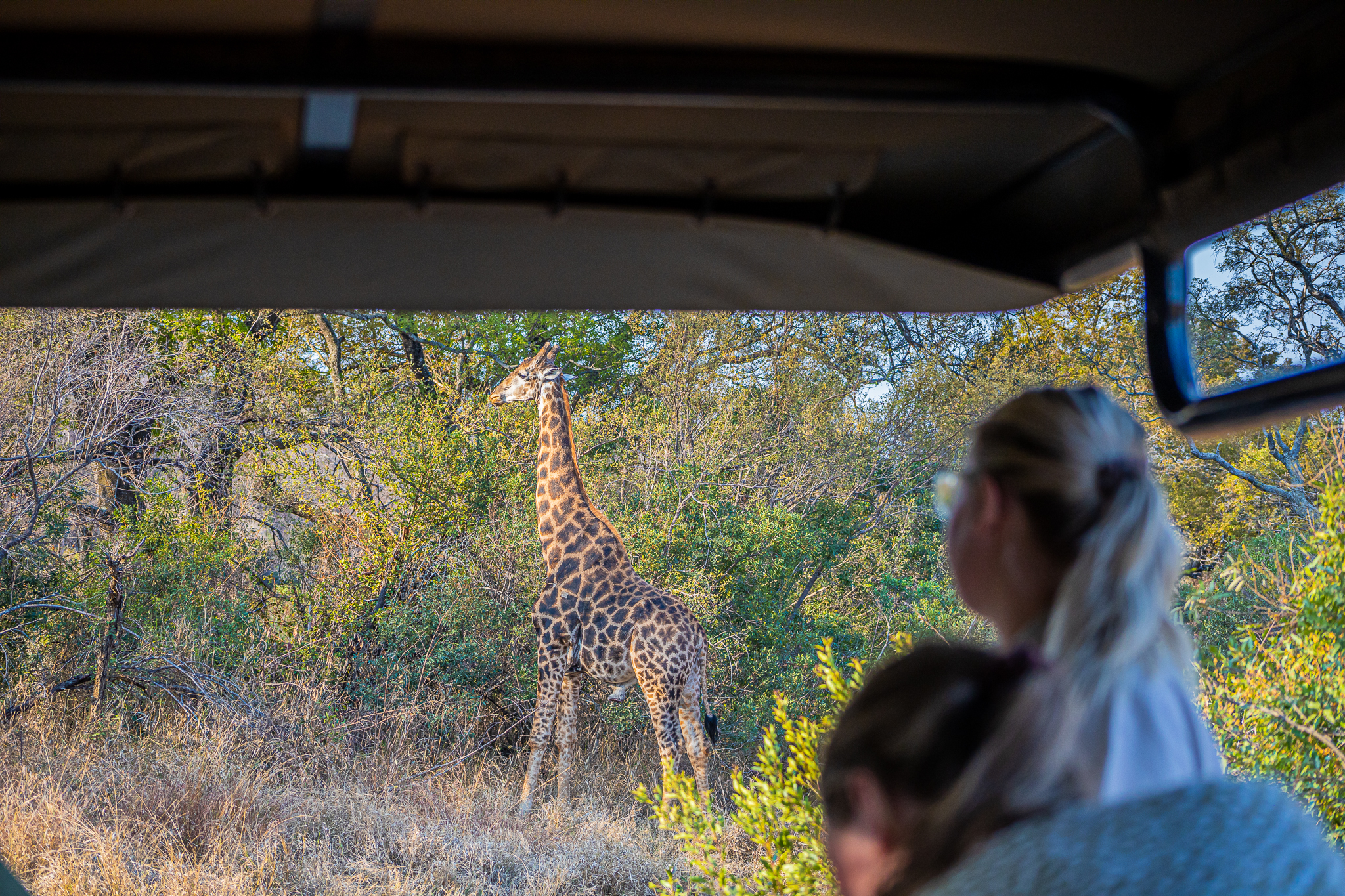
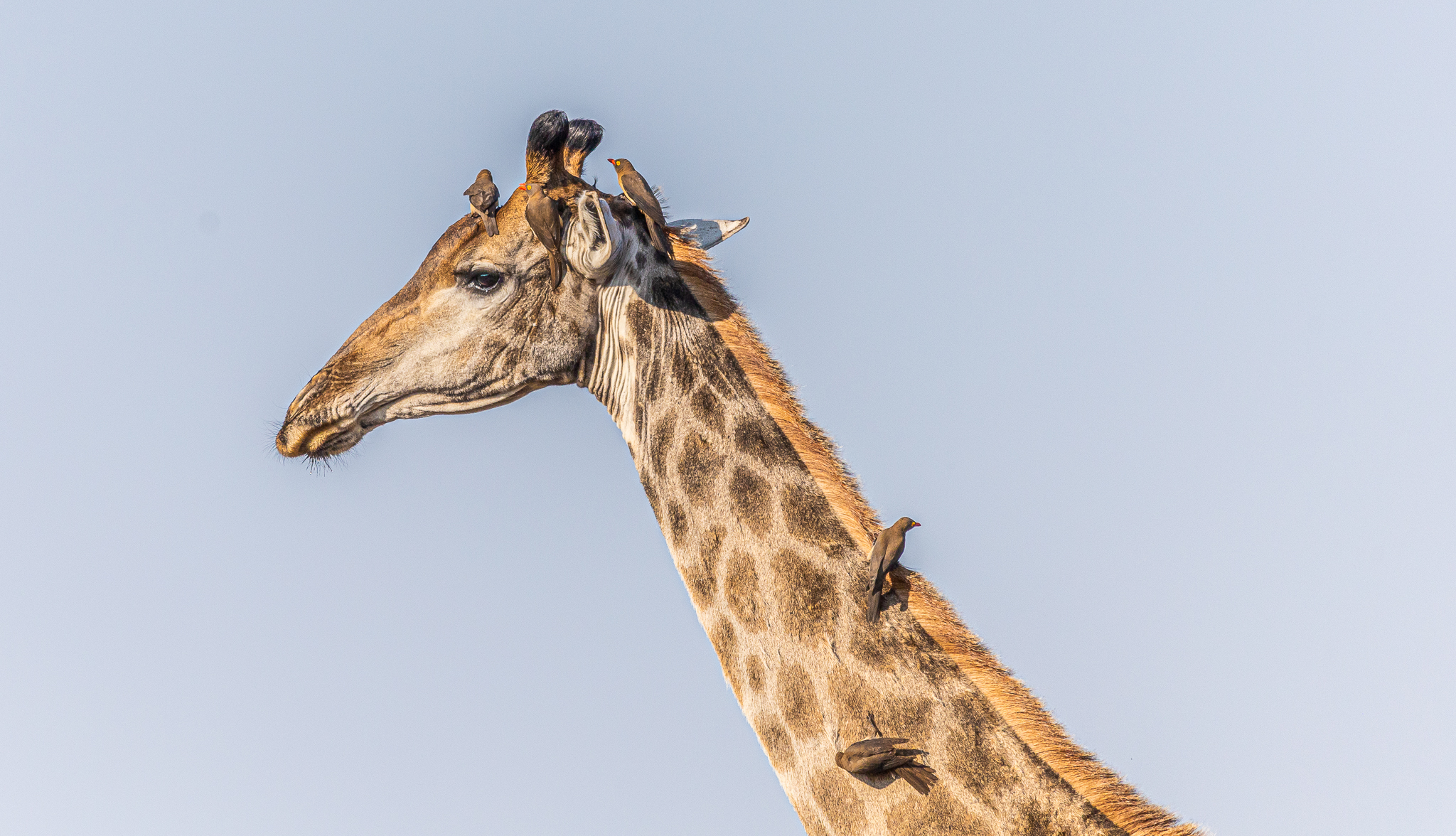
    A giraffe’s height is nothing short of impressive. Males can reach a staggering 5.48 metres (18 feet), while females are generally a little shorter, growing up to around 4.26 metres (14 feet). Their long, sturdy legs – each about 1.82 metres (6 feet) in length – provide the strength and balance needed to support their size.

    Of course, it’s the neck that steals the show. A giraffe’s neck can stretch up to an incredible 3 metres, yet they have the same number of neck vertebrae as humans – just seven. Despite this impressive anatomy, giraffes face a rather awkward challenge when it comes to drinking water. Their necks are too short to reach the ground on their own, so they must bend their legs in a strange, splayed position to lower their heads. Thankfully, giraffes don’t need to drink all that often. They can go for weeks without water, absorbing most of their hydration from the leaves and plants they feed on.
    image

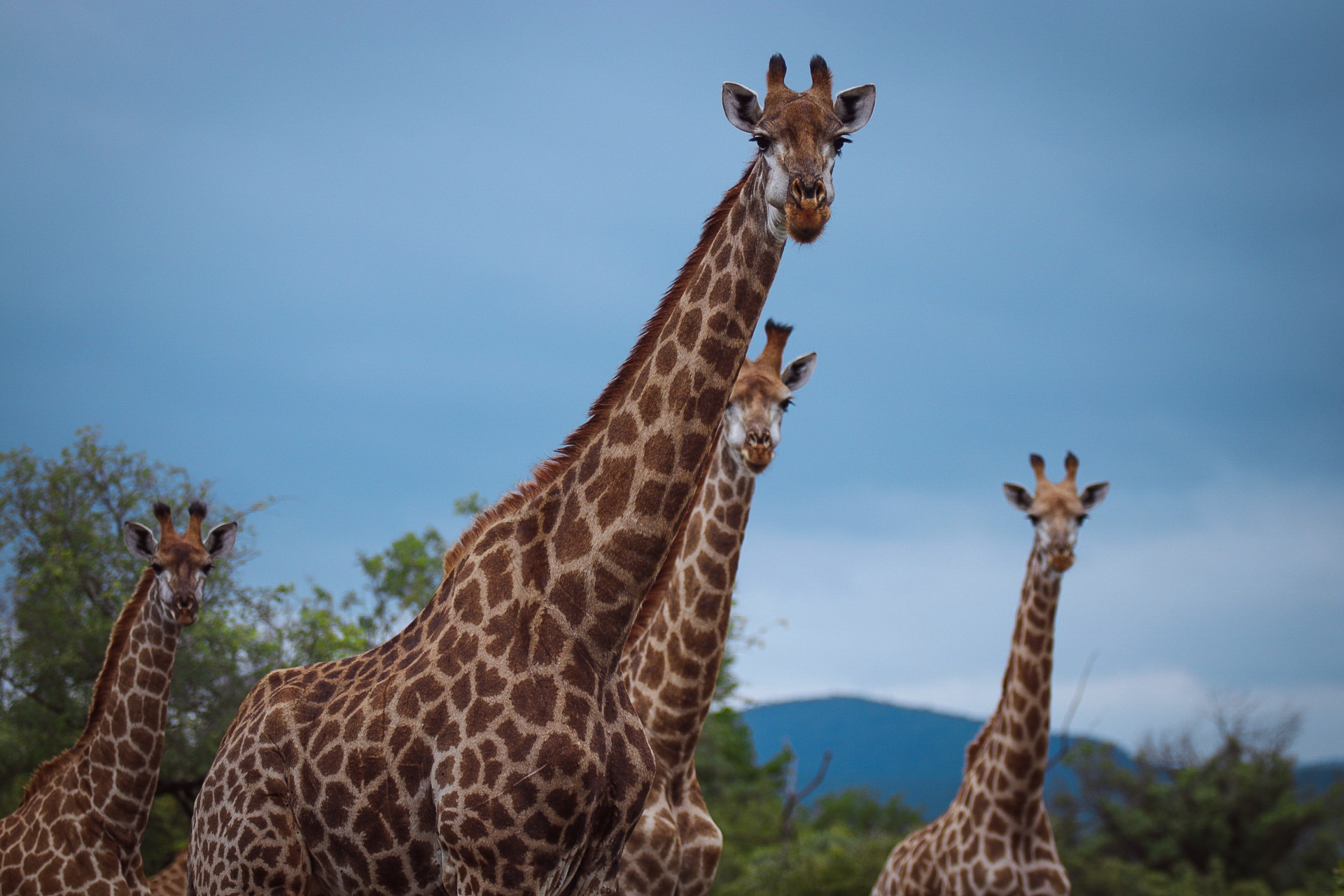
    Giraffes are sociable animals and live in loose, ever-changing groups known as “towers” or, occasionally, “journeys”. Unlike many herd animals, giraffes don’t follow a strict hierarchy. Instead, they interact in a calm, easy-going way. Group sizes can range from just a few individuals to over 20, and the makeup of the group can shift regularly. Female giraffes often form smaller, more stable groups, particularly when raising calves. Males, on the other hand, tend to roam more widely and are commonly seen in bachelor groups, especially during the mating season when they compete for dominance and the right to breed.

    Beyond their striking appearance and social habits, giraffes play a vital role in the health of their environment. As browsers, they help manage the growth of trees and shrubs by feeding on them, preventing certain species from becoming overgrown. This helps maintain a balanced and diverse ecosystem, benefiting countless other species. In a way, giraffes are the quiet gardeners of the savannah. They are also an important part of the food chain, particularly for predators like lions. While their sheer size offers some protection, calves are particularly vulnerable to predation.
    image

    The giraffe’s unique adaptations, peaceful social lives and ecological importance make them a treasured part of Africa’s wild landscapes. Sadly, some giraffe subspecies – such as the Rothschild’s giraffe – are listed as vulnerable, with their numbers declining due to habitat loss and other human pressures. However, thanks to the efforts of conservation organisations working to protect their habitats and raise awareness, there is hope. These initiatives are helping to ensure that giraffes – with their graceful silhouettes and gentle demeanours – continue to roam Africa’s wild areas for generations to come.
  • The humble dung beetle: Nature’s unsung hero

    This blog was written by Cari van Eeden, a Bushwise Professional Safari Guide student. Each student takes a turn as camp manager, and writing a blog is part of the experience.

    “It seems to me that the natural world is the greatest source of excitement, the

    greatest source of visual beauty, the greatest source of intellectual interest. It is the

    greatest source of so much in life that makes life worth living.” – David

    Attenborough.

    Dung beetles, known across the world, often go unnoticed. However, during my time at Bushwise, I learned just how crucial they are to the environment.

    image

    The crucial role of dung beetles

    Dung beetles are vital to maintaining a healthy ecosystem. During the summer months, they play an essential role by burying dung, which, as it decomposes, returns nutrients to the soil. This process improves soil structure and supports plant health. Additionally, they help control pests like flies, which can spread disease. By moving dung, they also assist in seed dispersal, unknowingly giving plants a helping hand.

    Dung beetles: The silent workers

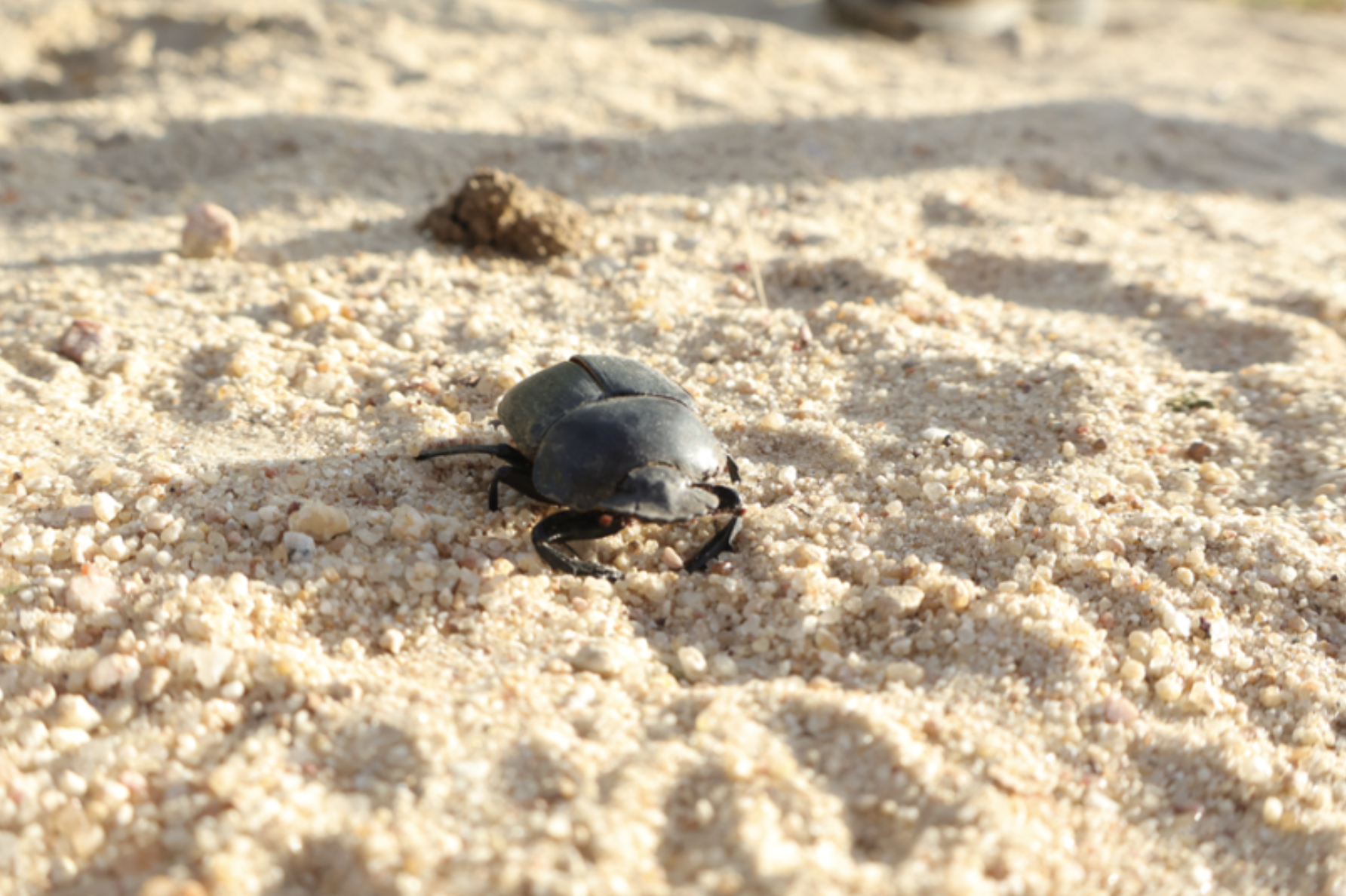
    There are four categories of dung beetles. One group, known as telecoprids, is particularly interesting. These beetles roll balls of dung away from the dung pile, then bury them in soft soil. This not only helps the nutrient cycle but also plays a large role in the biodiversity and beauty of our surroundings. As field guides in training, we quickly recognise how valuable these creatures are, so we make it a point to drive around them while they’re busy at work. It’s also important for us to share the significance of their work with guests during future safaris.

    image

    The fascinating dung ball

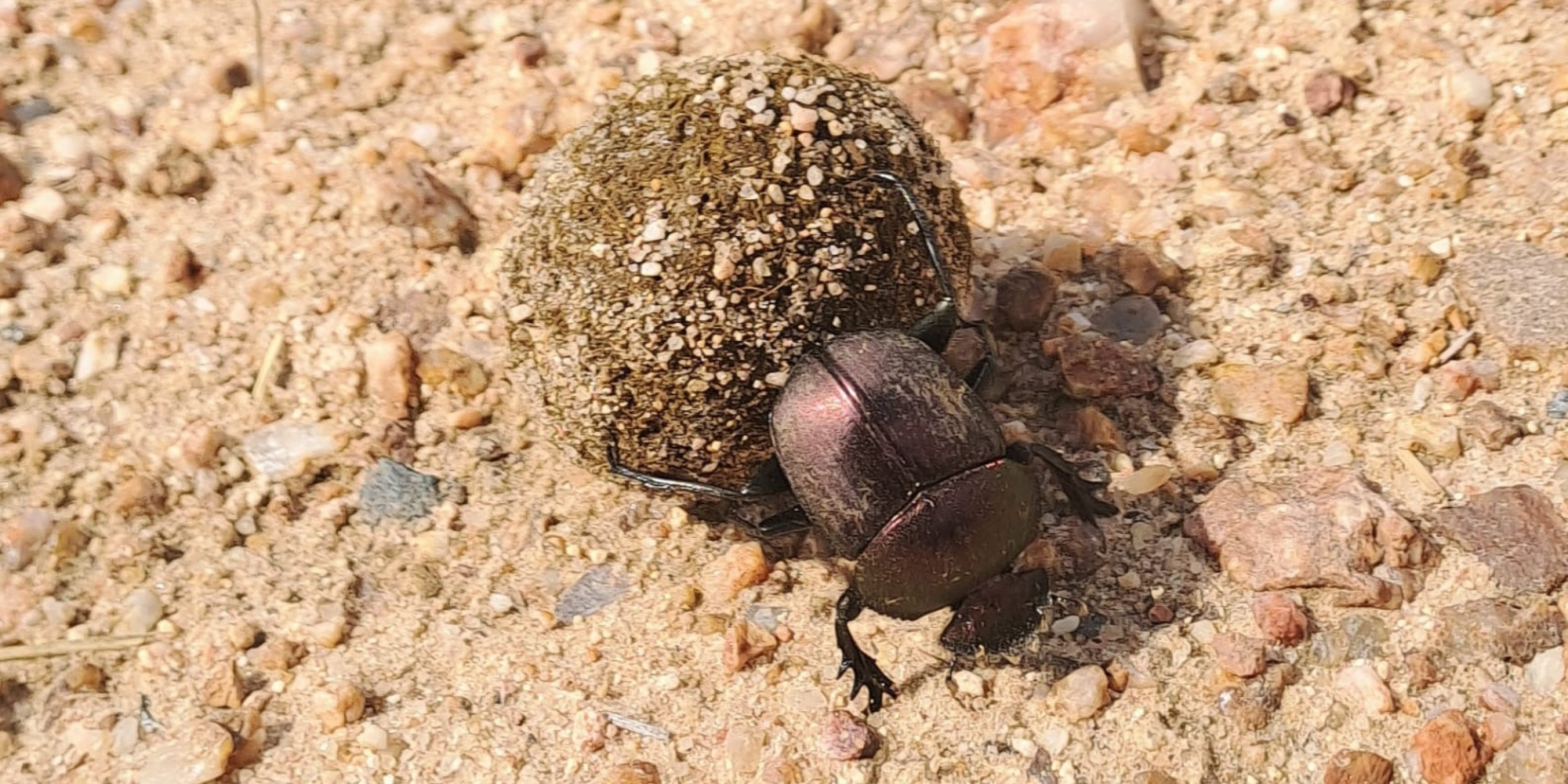
    So, why the dung ball? Dung balls serve two primary purposes. They are either used as a food ball, providing nourishment, or as a brood ball, where females lay their eggs. Sometimes, both. 

    Brood balls are fascinating. Often, one beetle clings to the ball while the other pushes it along with its hind legs. The male does most of the heavy lifting, rolling the ball far from the dung pile. Once he finds soft soil, they both dig and bury the ball, allowing the female to lay her eggs inside. This is a perfect example of teamwork in action. The ball ultimately serves as both a food source and a home for the developing larvae. It’s incredible to think that such a small creature can push 50-80 times its body weight.

    Other interesting dung beetles

    There’s also a group of dung beetles called endocoprids. These beetles don’t roll dung but instead dig tunnels beneath the dung piles. Then, there are the paracoprids, who skip the rolling and tunnelling altogether. Instead, they hop onto the dung and lay their eggs right there, though this method comes with the risk of being trampled by larger animals.

    Lastly, the kleptocoprids are beetles that steal dung balls from other beetles, often after a fierce struggle.

    image

    What we can learn from the dung beetle

    Facts aside, these remarkable insects offer valuable lessons: Firstly, there are many ways to achieve the same goal, so avoid comparison. Secondly, never underestimate the power of the “smallest” among us. And lastly, you are often stronger than you realise.

    Ready to learn more about nature’s incredible creatures firsthand?  Explore our wildlife courses to begin your journey into field guiding.

  • Everything you need to know about the greater kudu

    This blog was written by Whian Kruyshaar, a Bushwise Professional Safari Guide student. Each student takes a turn as camp manager, and writing a blog is part of the experience.

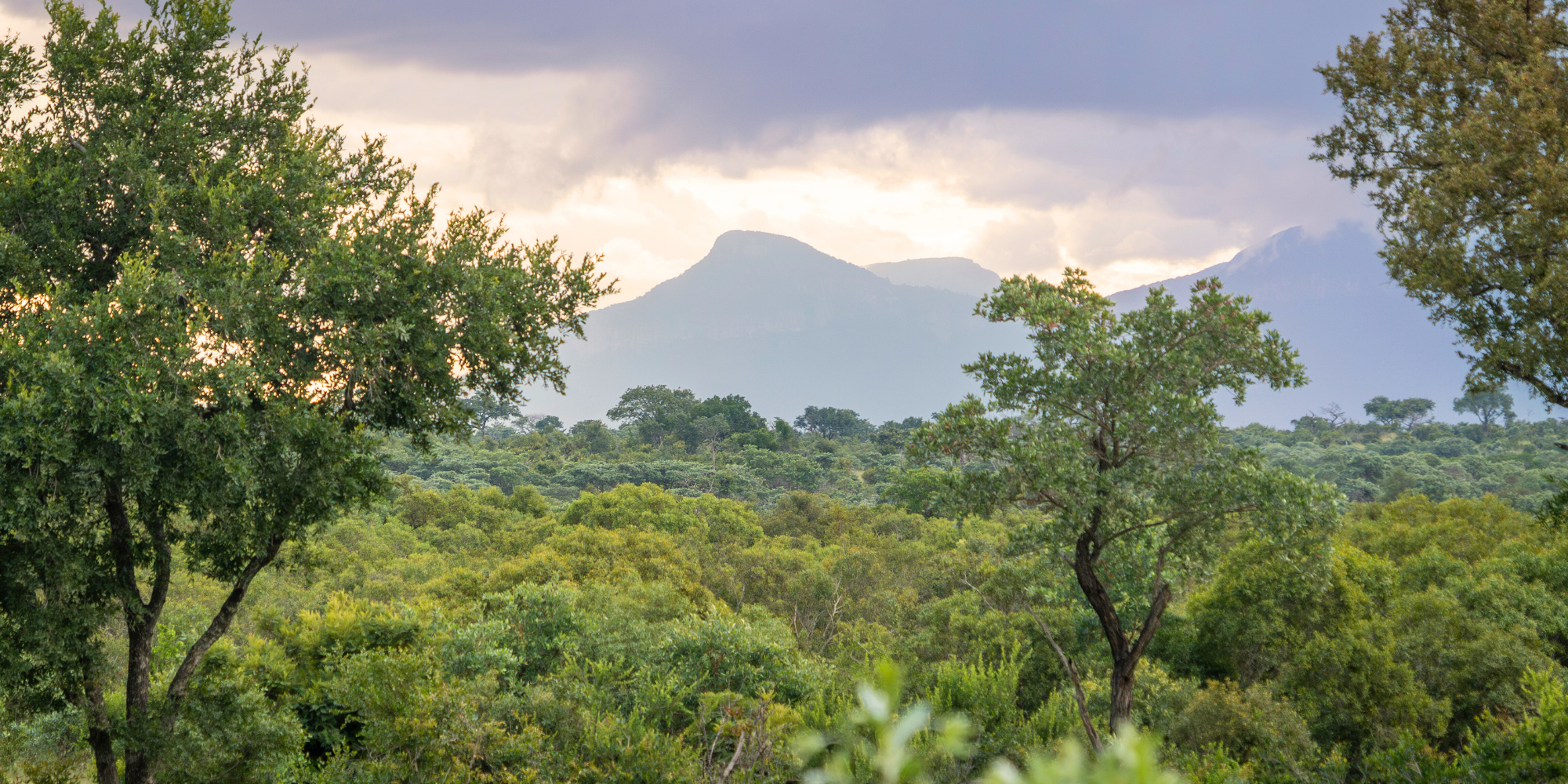
    The Kruger National Park is one of Africa’s most famous wildlife reserves and is home to a variety of animals. Among them is the greater kudu, which stands out as one of the most striking and elegant antelope species. With its spiralled horns, sleek body, and distinctive markings, the kudu is truly a magnificent sight to see. 

    A closer look at the greater kudu

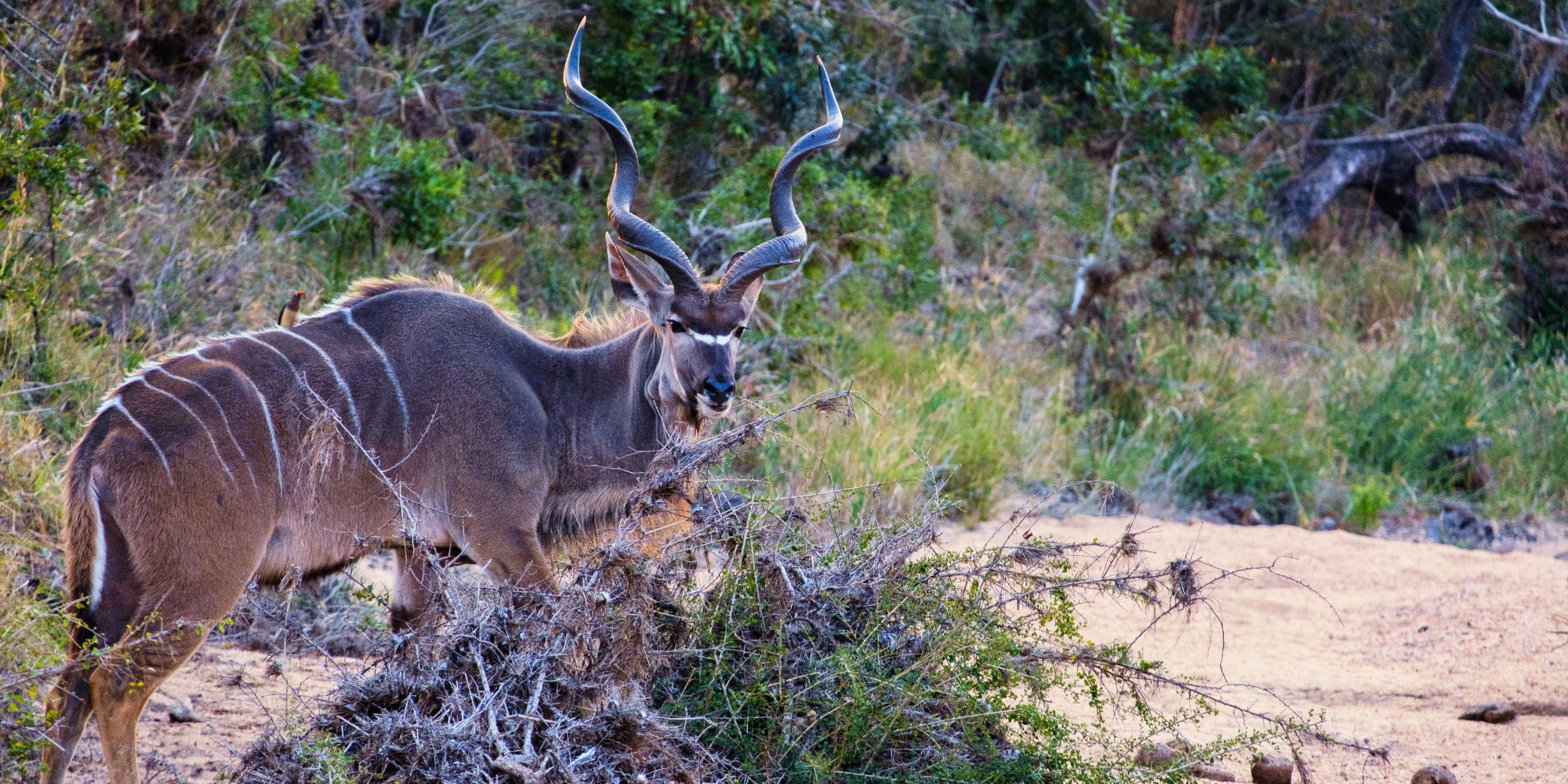
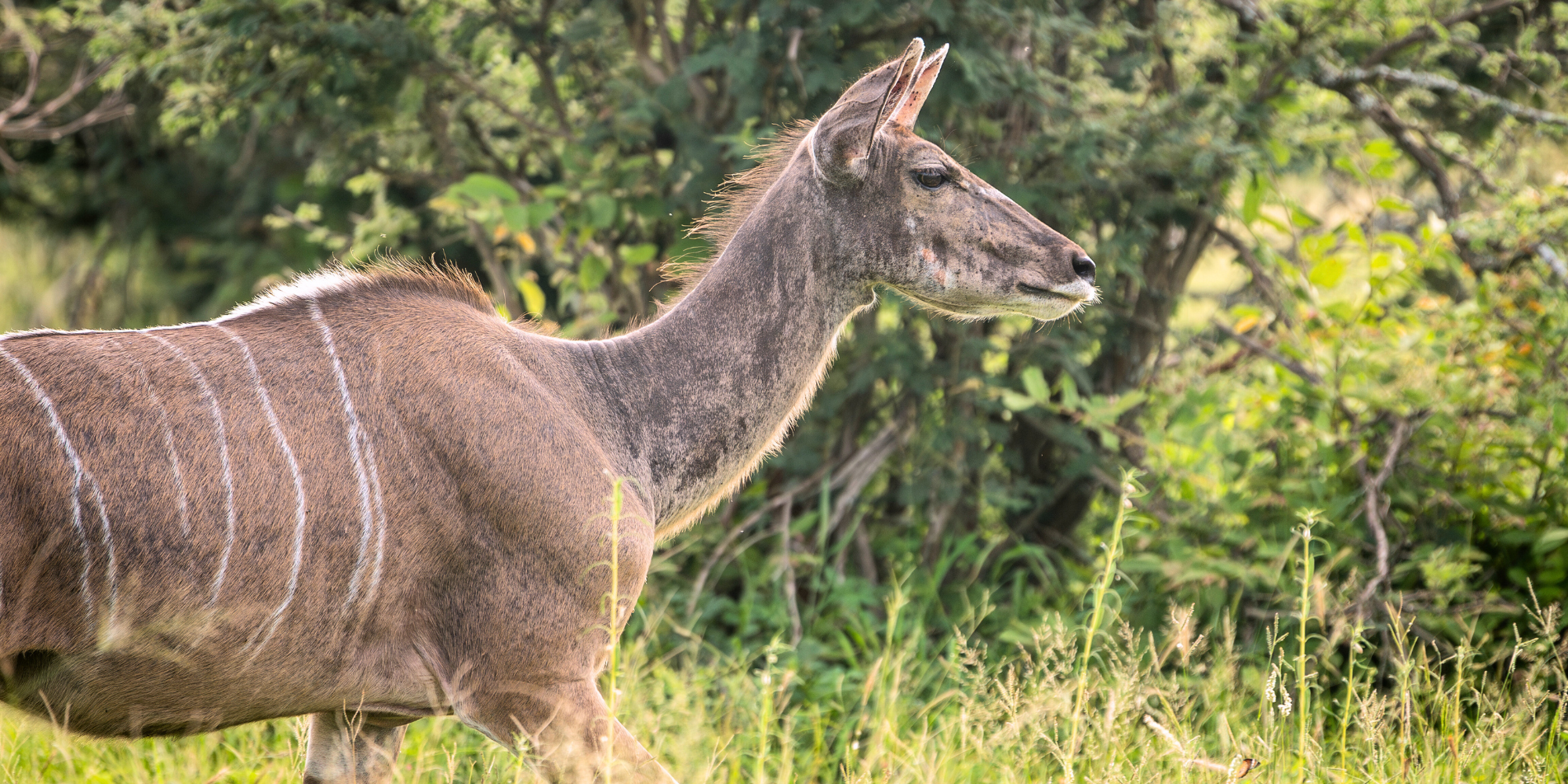
    The greater kudu is one of Africa’s largest antelope species, admired for its majestic presence and elusive nature. Males can weigh up to 315 kg (694 lbs) and boast impressive, spiralling horns that can reach up to 1.8 metres (6 feet) long. These horns contribute to the kudu’s regal appearance. Females are smaller and don’t have horns, making them easier to identify.

    image

    One of the defining features of the greater kudu is the colour of its coat. It has a tawny or greyish-brown fur, marked with white vertical stripes along its sides, which provide excellent

    camouflage in the dappled light of the African bush. This colouration helps them blend

    seamlessly into their surroundings, making them harder for predators to spot.

    Where to find the greater kudu in the Kruger National Park

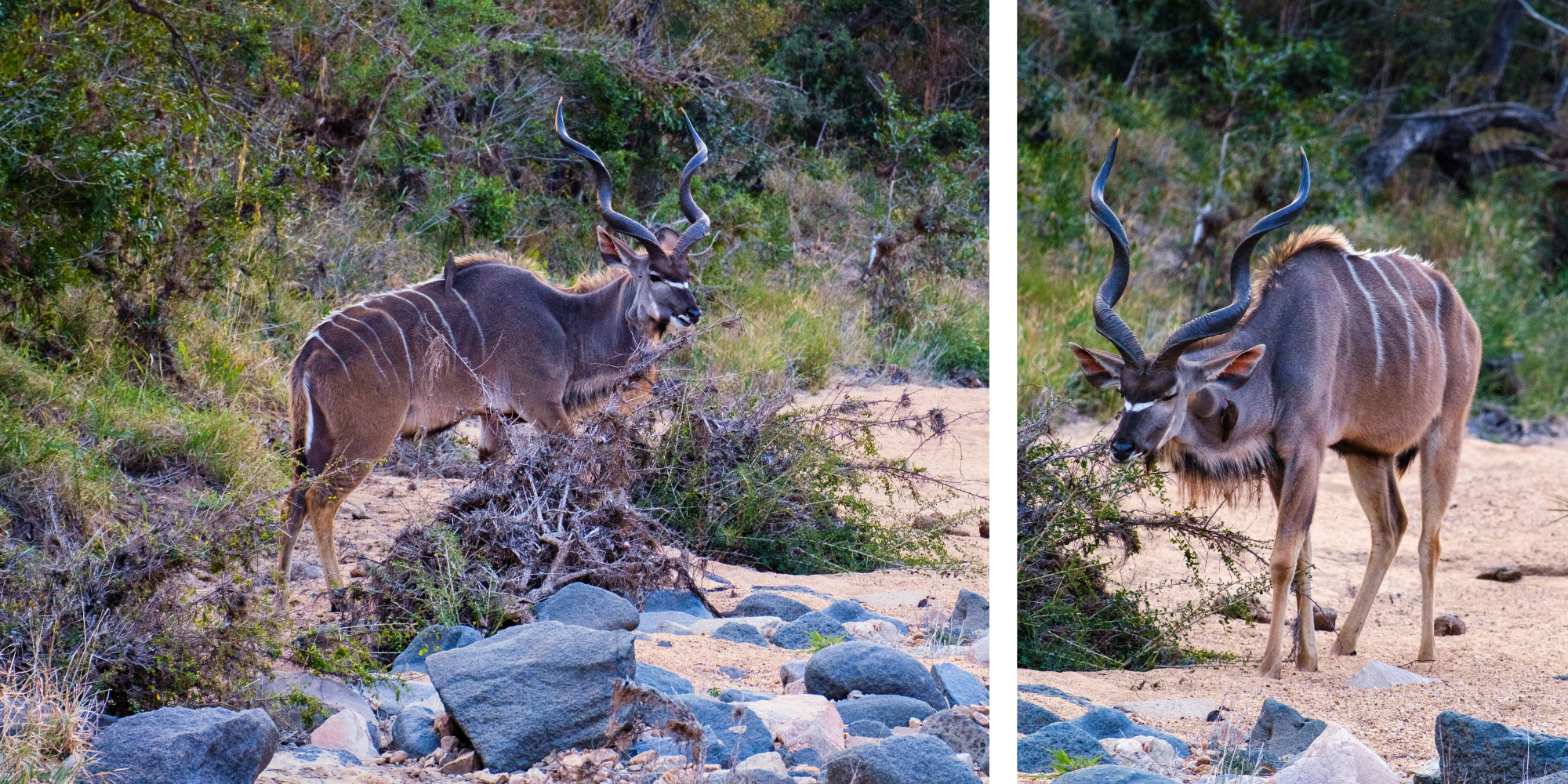
    Kudus are found in a range of habitats across Kruger National Park, but they prefer dense

    woodlands, thickets, and bushveld regions. They are commonly seen in areas with lots of

     tree cover, such as along riverbanks or near mopane and acacia forests. 

    Kudus prefer areas with more tree cover, likely because of their feeding habits. As browsers, they mainly eat leaves, fruits, and flowers, so it makes sense they’re drawn to regions with plenty of trees.

    image

    Behaviour of the greater kudu

    Despite their size, greater kudus can be shy. Unlike more social antelope species, kudus tend to be found by themselves or in small groups, usually consisting of females and their young. Males are often solitary except during the mating season when they compete for dominance and mating rights.

    Kudus are most active during the early morning and late afternoon, making these the best times to spot them on a game drive. They are, however, able to stand still for long periods, which can make them challenging to see, given that they blend perfectly into the bush. However, their loud and distinctive alarm call, similar to a dog’s bark, can sometimes give away their presence.

    Predators and survival strategies 

    Lions, leopards, and wild dogs are among the main predators of greater kudus. Their primary defence mechanism is their agility, speed, and ability to jump as high as 3 metres. They also have an excellent sense of hearing – especially with those large ears – and smell that usually allows them to pick up any signs of predators in the area. 

    How the kudu fits into the ecosystem

    As browsers, kudu play a role in controlling vegetation growth and helping with seed dispersal. They spread seeds by defecating what they’ve eaten but not fully digested while moving around. And, of course, they’re also an important food source for predators.

    Conservation status

    Although greater kudus aren’t considered endangered, they do face threats from habitat loss and human activities outside protected areas. In some regions, they can also be vulnerable to diseases like anthrax, which can occasionally affect their numbers. However, this is less of a concern in game reserves that focus on strict conservation efforts while maintaining a healthy, balanced ecosystem.

    image

    Spotting a greater kudu is always a treat, whether it’s a lone male with his striking spiral horns or a group of females and their young moving elegantly through the bush. While they may be fairly common in some areas, it’s worth taking a moment to appreciate their role in the ecosystem – and to look a little closer to rediscover the magic of these incredible animals.

    Want to experience Africa’s wildlife up close? Join a Bushwise course and learn from experts while seeing incredible wildlife.

  • A wilder path: Why I quit my desk job for a life in the South African bush

    This blog was written by Aleisha Carter, a Bushwise International Field Guide student. Each student takes a turn as camp manager, and writing a blog is part of the experience.

    3 min read

    I used to be an Executive Assistant. A bubbly joker of an Executive Assistant to a wonderful Executive Director in the heart of Brisbane, Australia. My biome was the concrete jungle filled with twinkling glass skyscrapers and dilapidated old buildings waiting to be bought out and replaced with even more twinkling glass skyscrapers. My flagship species was the roaring city buses, all filled with different assortments of workers and, keeping with my current theme, tiny parasites. Okay, yes, I mean lice. 

    Life in the concrete jungle biome was defined by the scent of coffee every morning, followed by the unfriendliness of people waiting for those coffees to work miracles. Life inside the twinkling glass skyscraper home ranges was defined by eye strain from staring at three computer screens for eight hours a day, ticking the seconds on the tiny computer clocks.

    image

    We choose the path of least resistance, right? I’d fallen into administration because I was good at it, it paid well, and the opportunity to climb up the corporate ladder meant very nice moolah (money) if I stuck at it. But there’s something missing in this scenario – job satisfaction, happiness, contentment. 

    Thanks to my job being inside, I was suffering from a serious lack of not just vitamin D, but also vitamin joy! So, while volunteering in Finland in 2023 with 87 Siberian Huskies, I made a decision: I would pursue a career in something that brought me joy – animals. And so, I applied to study Zoology at university and I got accepted!

    Unfortunately, I simply could not commit to living in the concrete jungle for three straight years while I completed my degree. Call it whatever you want – commitment issues, a travel itch, a yearning for something BIG – I felt that there was something else out there for me, another pathway I could take to pursue my dream of escaping the desk and being surrounded by animals every day. And then I found it, or more specifically, it found ME! It was like the sky opened up, and a choir of angels started singing as I laid eyes on the description of the Bushwise Field Guide Course, courtesy of my Instagram targeted ads. It had everything I had desired to learn in the zoology course, but implemented in a practical setting to get me out into the real world NOW.

    An interview, a deposit, many appointments and visa stresses later, and I was on the plane to South Africa to pursue this dream. Did I cry when I flew away from my previous biome and my previous home range and my previous role in this complicated ecosystem? No. Did I cry when I left my family, not knowing when I would see them again? Yes. But the beauty of this course is that I’ve accidentally found an entirely new family out here in the bush.

    image

    My new home range is a small village of bomas set in the savannah biome of South Africa. My territory is, in my humble opinion, the cutest boma in the village, stationed right outside the dining hall and bathrooms. Our flagship species is no longer the crowded buses and lice-ridden seats but the African Elephant and Leopard. No, we’re not parasite-free, but many impalas are here to nibble any ticks attached to their fur.

    My days are no longer spent in front of a screen, but instead I’m living out the scenes of my computer screensaver. We drive through herds of elephants, watch flocks of vultures take to the sky in wind thermals, track the prints of lions until we find entire prides. And then every night we eat together as a family, recounting the adventures and sightings of the day.

    I used to be an Executive Assistant. Now, I’m a Field Guide in training and I finally feel alive.

    Ready to leave the office and embrace a life in nature? Learn more about Bushwise courses and apply today to start your adventure as a field guide!

  • Sight, sound and seismic communication: the language of elephants

    2 min read

    It’s no secret that elephants are incredibly intelligent animals. They are known for their remarkable empathy, mourning the loss of individuals from their herds and working together to protect vulnerable members. Their social structures are complex, with matriarchs leading the herd and passing down knowledge through generations.

    You may have also heard about their ability to retain information over extended periods of time, storing memories of events, locations, and even the identities of individuals, and recalling them decades later. 

    Unique Communication Methods

    These majestic mammals have unique ways of communicating with one another, not only through sound but also through visual cues, touch, and vibrations carried along the earth’s surface. Their communication is intricate and multi-faceted, reflecting their deep social bonds and cooperative nature.

    image

    Long-Distance Messaging

    Elephants can send long-distance messages to each other through a process called seismic communication. These low-frequency rumbles travel across the ground, creating vibrations that are picked up by other elephants through their sensitive feet. These vibrations can reportedly travel over 2 kilometres and allow elephants to communicate over vast distances, even when out of sight of one another. This ability is particularly important in dense forests or open savannahs where herds may be spread out.

    Identifying a Familiar Face

    A recent study showed that elephants actually “call” each other by name when communicating. African elephants in Kenya have been observed calling out to their friends using rumbles and grumbles that are specific to each individual, much like humans use names. This is a rare phenomenon in the animal kingdom.

    image

    Understanding Body Language

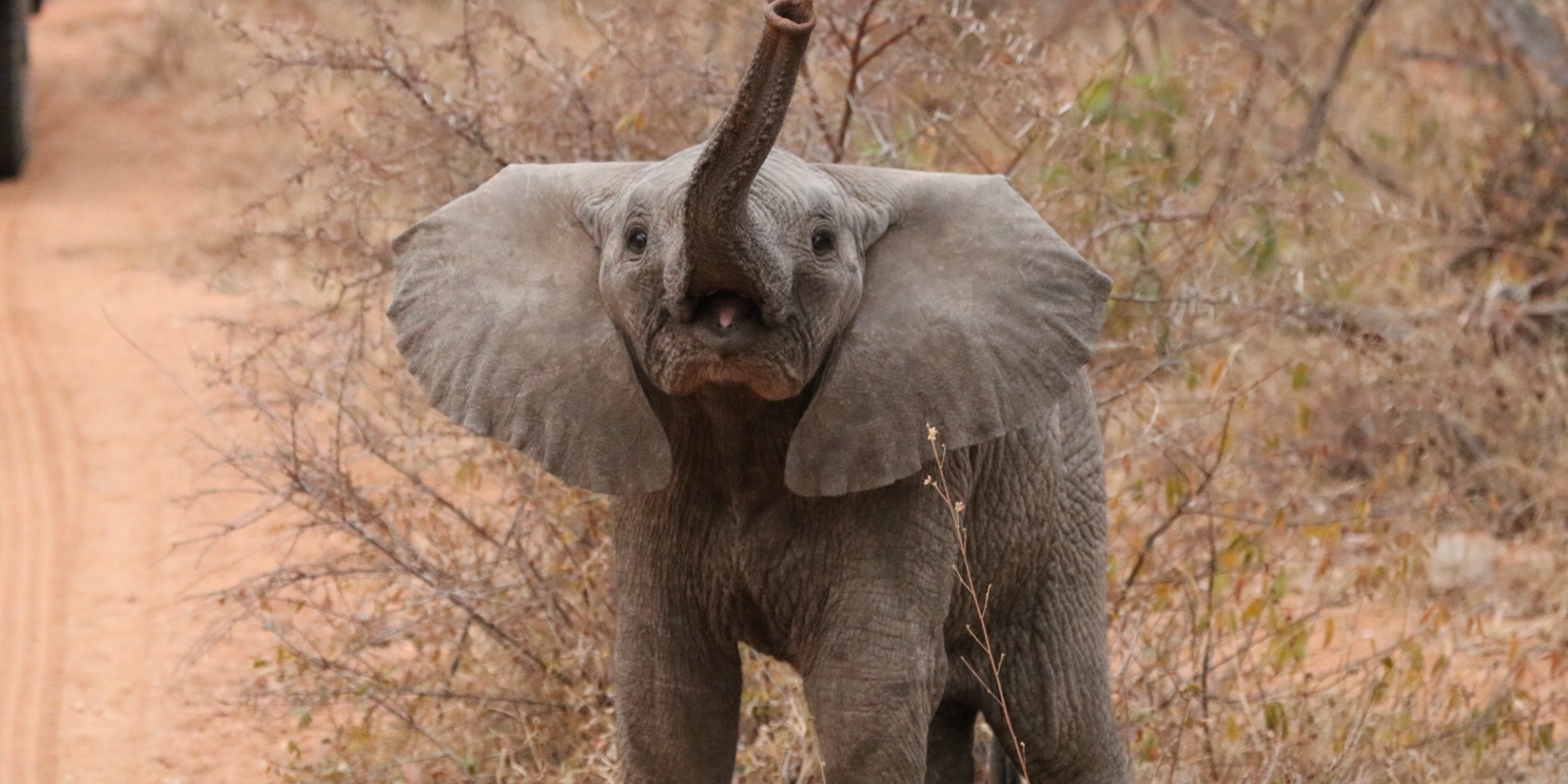
    From curling their trunks to flapping their ears and lifting their tails, elephants use their bodies in numerous ways to communicate messages to members of their herds as well as to other species. These movements can be bold and obvious, or subtle and nuanced, used to display dominance, show aggression, signal arousal, and convey a range of other emotions and intentions. For example, a dominant elephant might spread its ears wide and raise its head high to appear larger, while a submissive one may tuck its tail and lower its head.

    The Importance of Touch

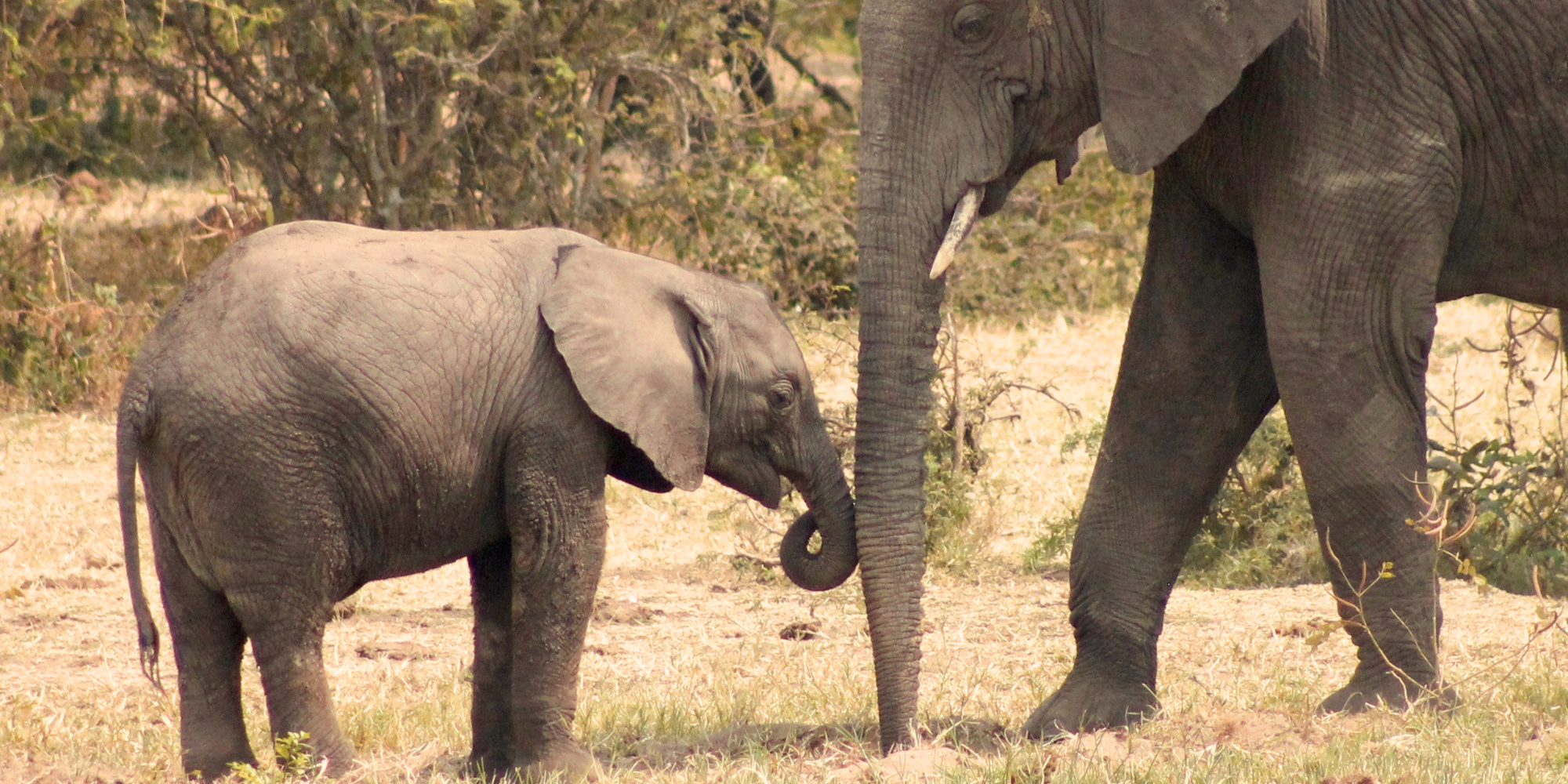
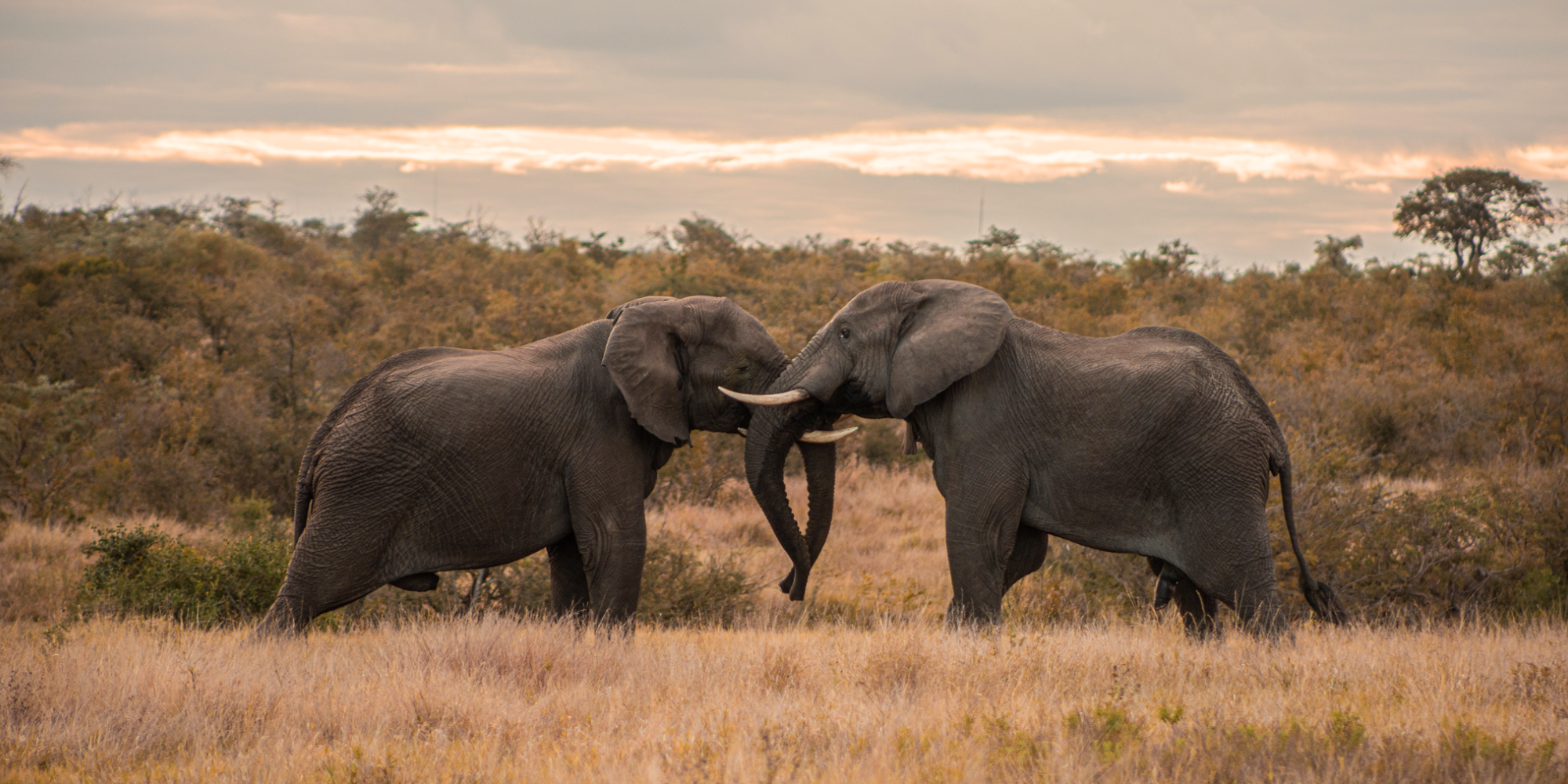
    As highly social creatures, touch is an essential communication tool for elephants. A gentle caress with the trunk can be used to display affection, offer reassurance, or protect a calf, while the rubbing of ears against another individual is often playful in nature. In more aggressive interactions, trunks can be used to slap another individual, while the entire body can serve as a weapon to ram into others. Touch helps reinforce social bonds within the herd and is crucial for maintaining the hierarchy and cooperation among its members.

    image

    The language of elephants is as complex as their social structures. Understanding their communication methods not only deepens our appreciation for these magnificent animals but also highlights the importance of protecting them and their habitats. Every gesture, rumble, and touch tells a story—one that we are only beginning to fully comprehend.

    Fascinated by the world of elephants? Explore Bushwise courses to deepen your understanding of wildlife. Apply now to start your adventure in the bush!

  • The subtle art of becoming a field guide

    This blog was written by Ryan English, a Bushwise International Field Guide student. Each student takes a turn as camp manager, and writing a blog is part of the experience.

    4 min read

    For as long as I can remember, I’ve wanted to work with animals, but I’ve never known exactly how. The idea of working in an office surrounded by walls and cubicles sounds like one of the layers of hell, so I have set out to find a way to be outside with animals for a living. 

    After finishing school, I decided to study zoology and natural science in university, but I had an itch to scratch with being back in the bush. Then it hit me when I spoke to my friends and family. Since you love telling people about animals so much, why don’t you do that for a while and see how you like it? Since that moment I knew being a guide in Africa would be my next adventure. 

    image

    Starting the process 

    The first step to following my aspirations of working in the bush was to leave my home city of Sydney, Australia, for South Africa where I would travel six hours from Johannesburg to the foot of the Klein Drakensberg, in the Limpopo province. More specifically, the Mahlahla campus at Bushwise

    Out here there are no streetlights, paved roads, noisy planes flying overhead or noise through the night. It’s peaceful from the onlookers perspective. After spending some time here you’ll soon realise how much is really going on. The walk from the dining room to my bedroom alone is an adventure at night with eyes flashing back at me, bushes rustling and figures seemingly disappearing into the pitch-black night. 

    The day is filled with birds calling to each other, antelope running around while keeping an eye on you and the honey badgers waiting in the termite mounds or in a hole for a chance to raid the fridge.

    image

    The more you listen to all the sounds, the more you realise how complicated and intertwined it all is. Then you are hit with the sudden reality: “I need to know every little sound out here and what it all means.” This is when I was almost hit with a slight wave of panic. 

    I only have 6 months to learn as much as humanly possible out here. I need to be able to educate and answer questions for guests who may have spent their whole lives wanting to come out here. And it needs to be entertaining! I don’t know what every bird sounds like or what the trees are, let alone the types of grass or the differences in footprints between animals we only hear about in Australia. This is going to be a huge 6 months of intense learning. It feels like everyone around me somehow knows more than me in every subject despite most of the group I’m with also being from other countries and continents. 

    Then one night, I realised: “This is a great thing, I can learn from everyone here, not just the instructors.” This realisation quickly sparked my competitive nature. I can and will become the best guide I can be and I’ll do my best to take the best parts of my peers around me to make Frankenstein’s guide. 

    image

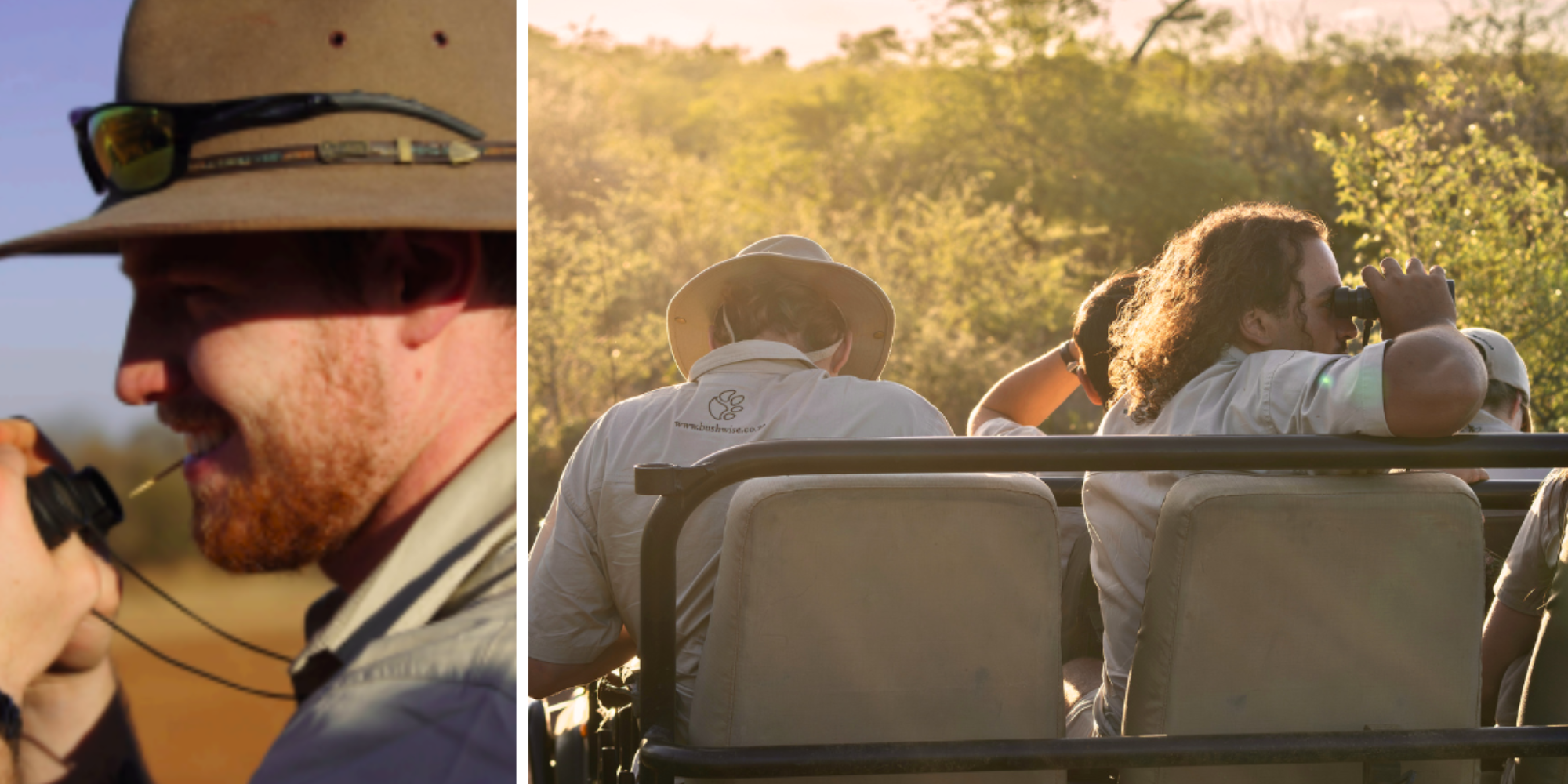
    There was a catch, it’s not all just about animals when you are a guide in the bush. We need to be a driver, photographer, host, protector, medic, comedian all while being a beacon of knowledge. 

    Our first two weeks of class have been composed of classes that I would not have guessed when I began this path of leaving Australia. We did wilderness first aid courses, a hosting class on wine, and a photography class to help our guests. We need to be a multitool in the bush and we need to be good at it. 

    Once our people skills have been learned we can start to scratch the seemingly bottomless pit of knowledge about our environment. We need to navigate the stars at night, understand the weather without a forecast, predict where animals are by the shape of the land and the colour of the soil. This depth of knowledge is intimidating but I’m up for the challenge. 

    Just as I think I’m on top of the workload, we are given weekly prep tests that instantly humble me. With a minimum pass mark of 75%, this course might be the death of me but, I’ve spent too long wanting this and too much money to fail so it’s time to put my head down and work until I have achieved the best I possibly can. It’s not just about the mark, though, it’s about being the best I can be, even if I don’t top the class in test marks I’ll still be able to say I did my best and will shine when I’m finally in the bush with people who want to learn and look to me for the answers. This course is hard, but all the best things are.

    Explore Bushwise programs today and apply now to start your journey in the South African bush!

  • Secrets of the trunk: an elephant-astic tool

    This blog was written by Meline Klopfenstein, a Bushwise Professional Field Guide student. Each student takes a turn as camp manager, and writing a blog is part of the experience.

    4 min read 

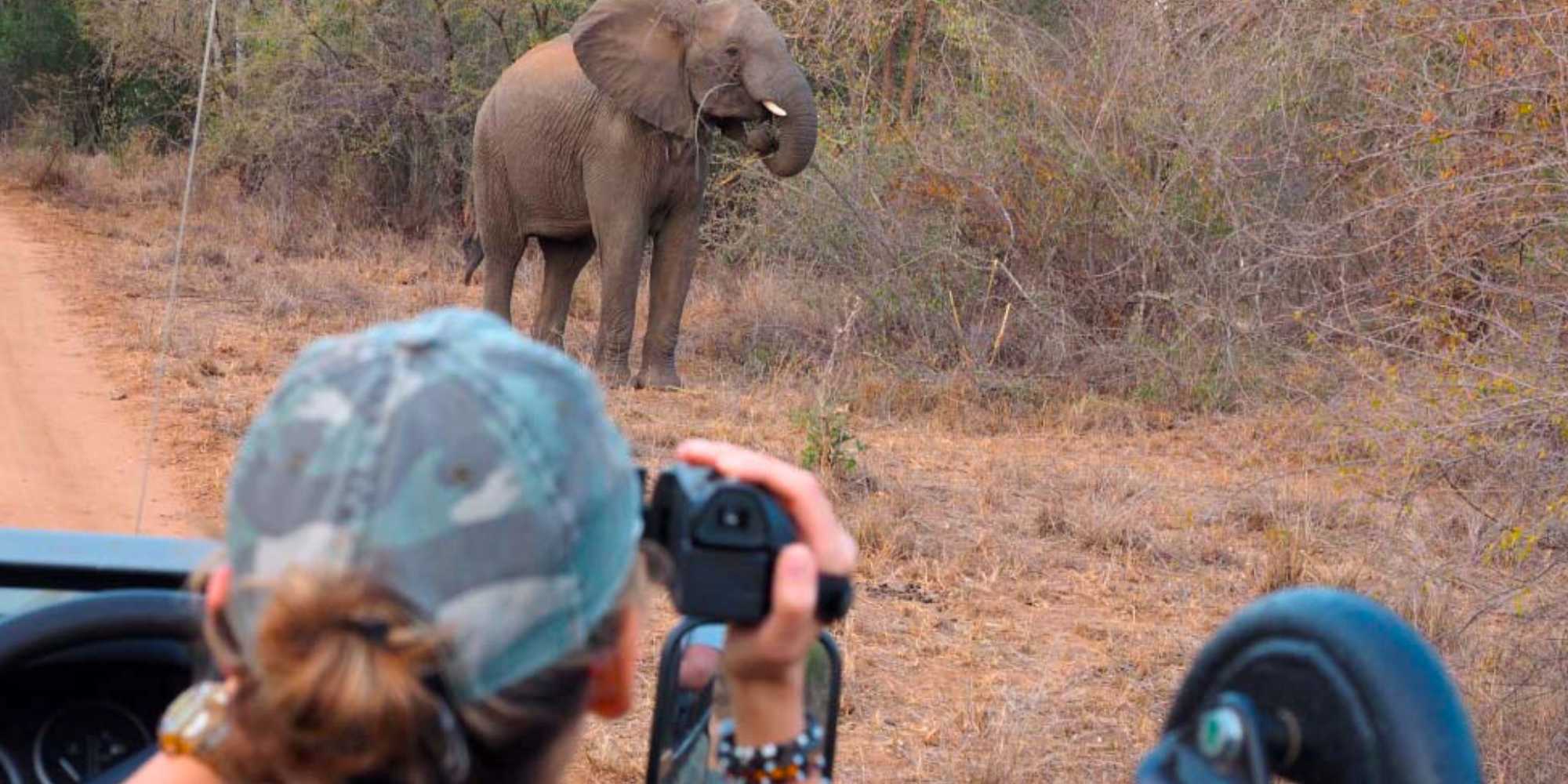
    One of the cutest events I have ever seen was an elephant calf trying to control its trunk. Can you imagine having to control up to 40,000 muscles at a time? Can you imagine being able to push a whole tree down with the trunk, but also, pick up a single shoot of grass? It is incredible!

    image

    What is it ?

    The trunk is the fusion of the upper lip and the nose of the elephant. It weighs up to 140 kg and measures between 1.5 to 2 m! It is one of the only appendages that is moveable without any bone structure. The arrangement and small size of the muscles, enable an acute control for fine movement, and an undeniable strength. The tip of the trunk is extremely sensitive as it contains a dense network of sensory receptors.

    The vital role of the trunk

    The trunk is a vital tool for the elephants. From shaking a marula tree to get the fruits, to gently caressing a calf, to simply breathing, elephants display immense dexterity and strength. It is used for feeding, drinking, communicating, and so much more.

    Elephants use their trunks to get food – be it twigs, fruits or grass – and bring it to their mouths. An adult elephant’s trunk can also carry up to 12 litres of water to the mouth. Sometimes we also see them putting their trunks in their mouths and then drinking. They have a pharyngeal pouch at the back of the mouth that serves to store water. It can hold about 4.5 litres of water, but without a trunk, it would not be possible for the elephant to use this water!

    The trunk is also vital for elephants to dust, mud, and water-bath. These activities are carried out as social interaction and bonding experiences, but are also important for many other reasons. It enables better thermoregulation by creating a protective layer over the skin and directly cooling down the elephant. It also maintains the skin in good health by moisturising it. Mud also plays insect repellent and antiseptic roles, helping with the healing of wounds.

    image

    Communication using the trunk

    Elephants also use their trunks to communicate in different ways. To start with, the long trunk enables the elephant to have an acute sense of smell. The genome of the elephant is composed of up to 2,000 functional olfactory receptor genes! To make a comparison, domestic dogs have about 800 and humans have 400 functional olfactory receptor genes. Smell is central to their survival. It allows them to find food, water and navigate their environment safely, as they are able to smell danger from a distance. Smell is also central in their communication with other elephants. 

    The trunk of an elephant is one of the most sensitive parts of its body. It is therefore often used for reassurance or bonding. A mother will sometimes gently caress the calf to make sure it is awake, following the group or to guide it. Upon greeting one another, or as they face danger, elephants will sometimes reach their trunk to the mouth of the other individual. Calves have also been observed sucking their own trunk. This was often in a situation where the calf showed signs of uncertainty or discomfort. It is thought to serve a reassurance purpose, just as a human child would suck his/her thumb when needing reassurance.

    Sounds elephants emit are varied. The larynx is situated in the throat of the elephant and is responsible for emitting most of the sounds: rumbling, trumpeting, infrasound. The trunk, however, can be used to modify the tones of the trumpeting, thus expanding the range of sounds possible. The trunk itself can also emit a kind of snorting sound, that shows high arousal.

    image

    It is also possible to read the state of mind of the elephant by the movement and position of its trunk. For example, a male in musth will display many recognisable behaviours such as curling and uncurling, or dragging the trunk on the ground. Dragging and bouncing the trunk can also be observed when threatening. I have seen young elephants playing and chasing birds, throwing their trunks forward to frighten them.

    Joyce Pool (Co-Founder and Co-Director of ElephantVoices) also believes that when elephants point their trunk straight to a direction or an object, it is to attract and direct the attention of other members of the group to this object, and not only for smelling. If an individual smells something and does not want to attract the attention of other members of the group, only the tip of the trunk will subtly move in the direction of the smell.

    With such a complex appendage, how do calves learn to use it?

    They are born with a trunk that is fully functional but they do not have the control over it. Controlling it is a colossal task and it takes up to a year for the calf to be fully comfortable. The calf will learn by observing the other members of the group and imitating. It is through a lot of trial and error that the calf gains control over its trunk.

    Want to learn more about the wonders of wildlife? Explore Bushwise courses and apply now to start your adventure in field guiding!

    Sources used:

    Longren, L. L., Eigen, L., Shubitidze, A., Lieschnegg, O., Baum, D., Nyakatura, J. A., Hildebrandt, T., & Brecht, M. (2023). Dense reconstruction of elephant trunk musculature. Current Biology, 33(21), 4713-4720.e3. https://doi.org/10.1016/j.cub.2023.09.007

    Kirstein, K. A., & Berlin, H.-U. zu. (2023). Giants with microscopic muscles: New findings reveal the structure of the dexterous elephant trunk. Phys.orghttps://phys.org/news/2023-09-giants-microscopic-muscles-reveal-dexterous.html

    Poole, JH., (n.d.). Ethogram table. Retrieved 27 April 2024, from https://www.elephantvoices.org/elephant-ethogram/ethogram-table/overview.html

  • How my passion for birding took flight

    This blog was written by Phoebe Gordon, a Bushwise Professional Field Guide student. Each student takes a turn as camp manager, and writing a blog is part of the experience.

    3 min read

    It seems there is some sort of addictive component associated with the South African bush. Something in the air, an almost tangible narcotic, that evokes this intense sense of passion and appreciation. I’ve seen it too. This industry is built on those who relish waking up in the early hours, who happily drive in 40 degree days, who tirelessly strive to satisfy guests and who only go to bed when all the work around the lodge is done. Their work ethic is unbelievable, and from a distance, seems almost a bout of insanity.

    I nearly verged on such insanity in the past week. The dreaded birding week. Don’t get me wrong, I love the odd bird now and then. Watching a little wren hop around or admiring the beauty of a regal eagle is an awesome experience. They are an intrinsic part of almost every ecosystem, from the penguins huddled on the sub zero plains of Antarctica to the smallest hummingbirds in the Amazon Rainforest. As a general nature lover, I can appreciate their beauty and importance, and in all honesty, I tried very hard to be interested. But learning to recognise 127 bird calls and 200 birds by sight, in a mere seven days, was quite the challenge. 

    I can highlight some of the difficulties:

    • They all look the same.

    • They all sound the same.

    image

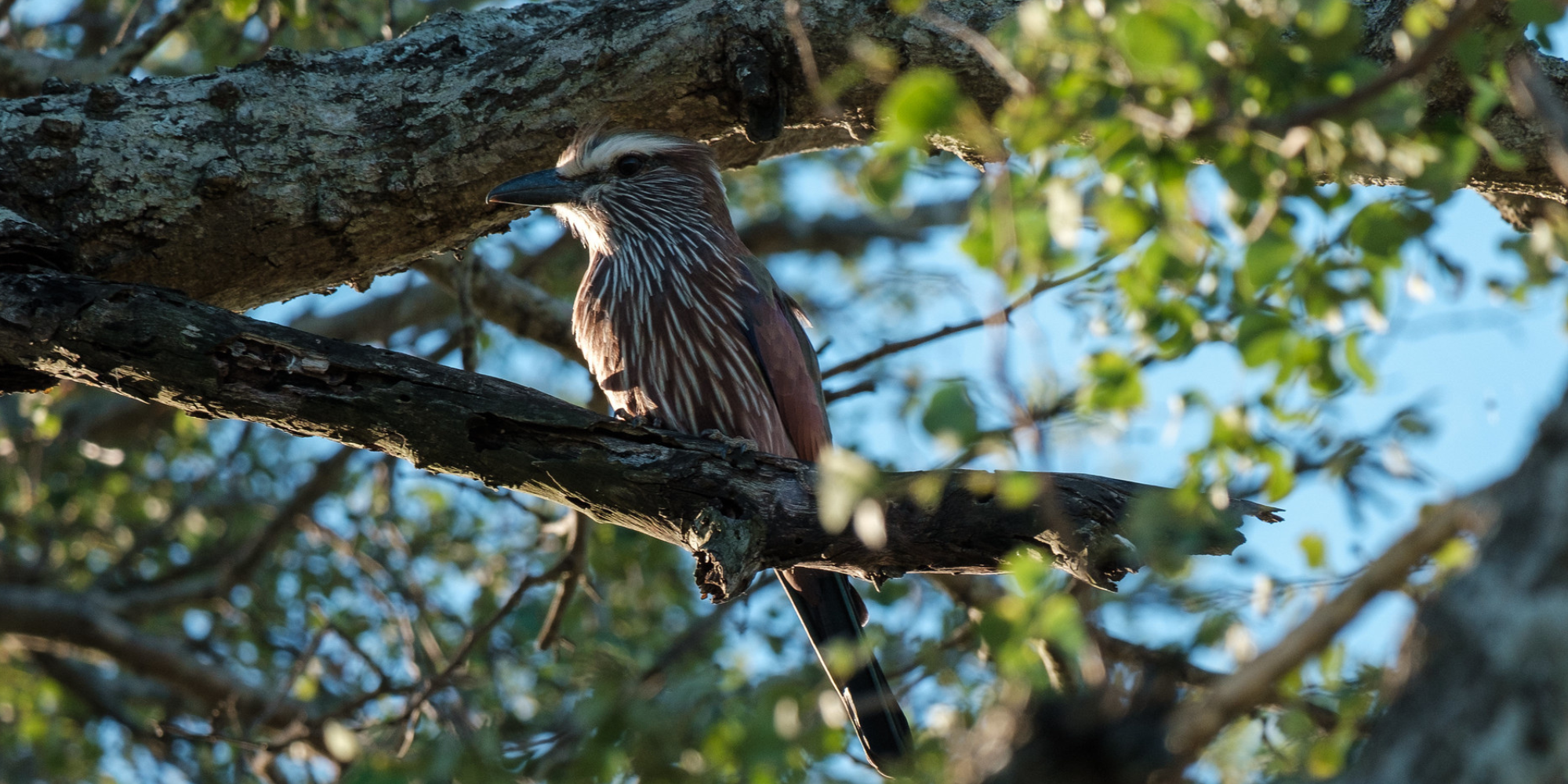
    In that week, I was not the positive guide who happily got up at 4:30 to go on a drive. Through exhaustion, I found it difficult to appreciate the birds – we were doing two 3-hour game drives a day, plus socialising, plus camp duties, and the remaining time was for studying. And it wasn’t even enjoyable information. But I had a test to pass, so I persevered; listening to the same squawk on repeat, or trying to see if a starling had red or black eyes. I couldn’t understand those around me that adored it – I even started wondering if some just have a genetic predisposition for birding.

    It was only on the Thursday, two days before the test, that I suddenly realised that I was enjoying it. I was excited to see if I could identify the birds on drive, or see one that I hadn’t seen before.

    And, just like that, I was hooked. I had transitioned, seemingly overnight, into a birder.

    image

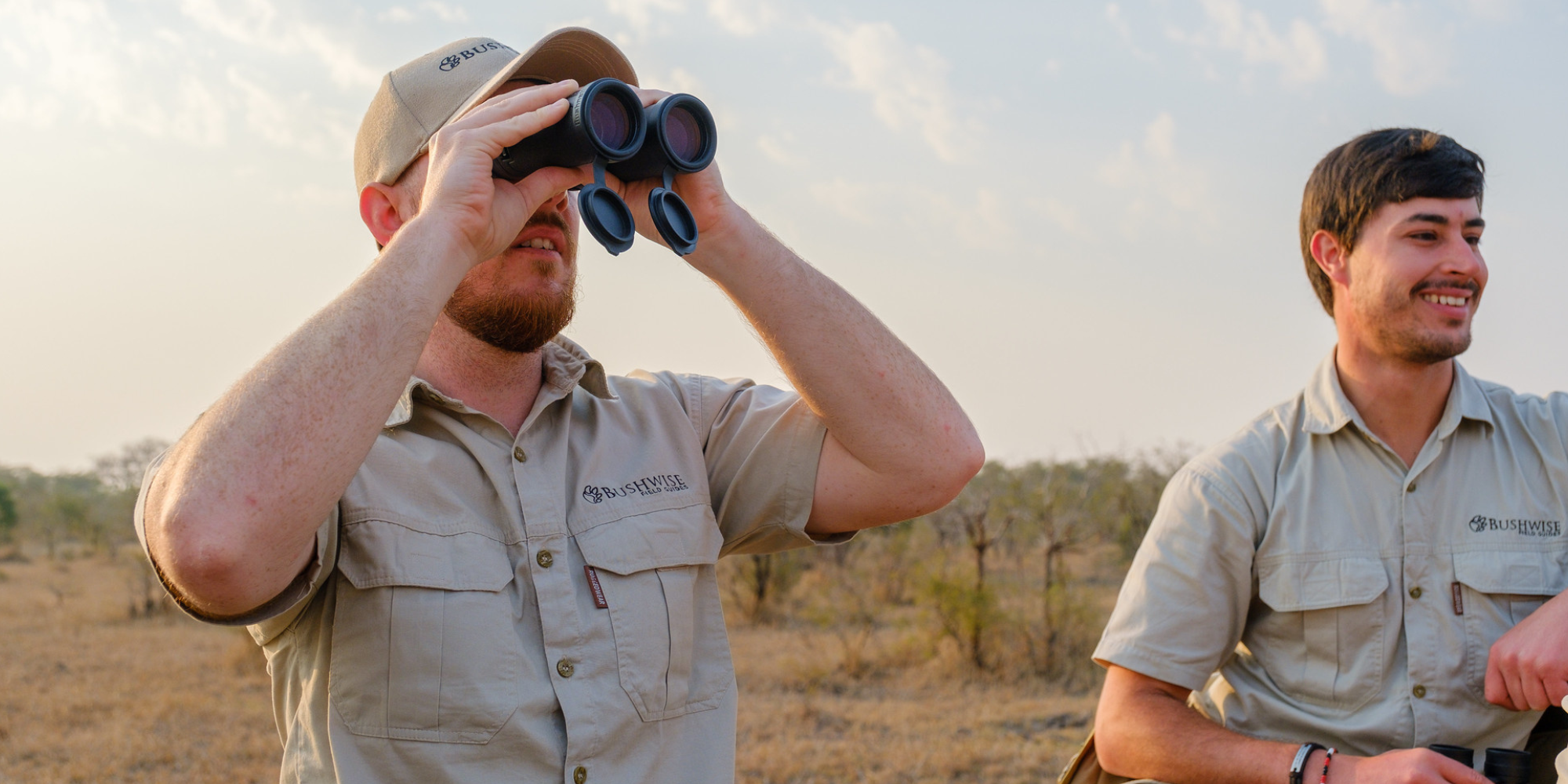
    I ordered a new pair of binoculars, and the latest version of Robert’s bird book. I wrote line after line on behaviours of the different species, and the minute differences that make all of them unique. Some examples:

    • The fiscal shrike will impale insects on the thorns of a specific tree in his territory, to exhibit his hunting skills as a method of impressing females.

    • White-backed vulture pairs will stay together for their entire lives.

    • Little swifts are almost exclusively airborne, and will only ever land for annual breeding purposes.

    • The oldest southern ground hornbill lived for 60 years.

    • The heaviest sociable weavers nest ever found weighed over 7 tonnes.

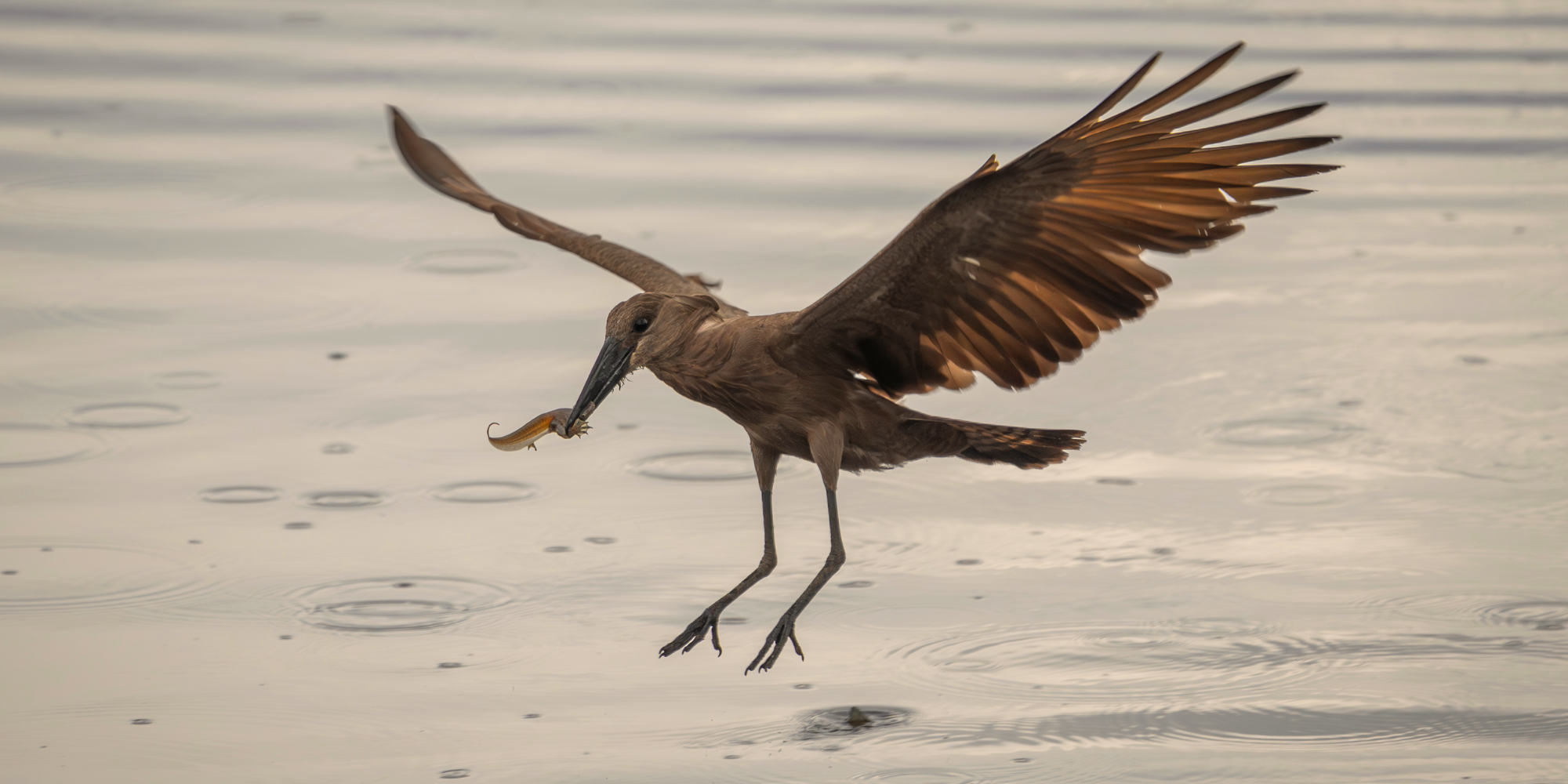
    • African harrier hawks have double jointed knees, to allow them to enter the holes of other birds to eat their eggs.

    • Ostriches can run at speeds of up to 70 km/hr.

    • Due to the muscle structure within their oesophagus, flamingos are only able to feed with their heads upside-down.

    I’m not going to say I’m an expert – far from it – but I am proud to say that I have developed a love of birding. 

    image

    I’ve come to realise that there is no secret ingredient in the food, or intoxicating chemical in the air, that compels people to return to the bush day after day, year after year. It isn’t even an inbuilt gene that means that some people adore birds or not. It is the pure nature itself that is so addictive, and the desire to understand the processes behind it, that are the driving forces. The raw experience, the unlimited things to learn, the intrigue of what we may never know. 

    Things are only ever boring if you don’t understand them.

    Want to explore your passion for bird watching? Join a Bushwise program today and get ready to soar.

  • Signs of life: Following the trail that leads back to me

    This blog was written by Cameron Dodge, a Bushwise Professional Field Guide student. Each student takes a turn as camp manager, and writing a blog is part of the experience.

    3 min read

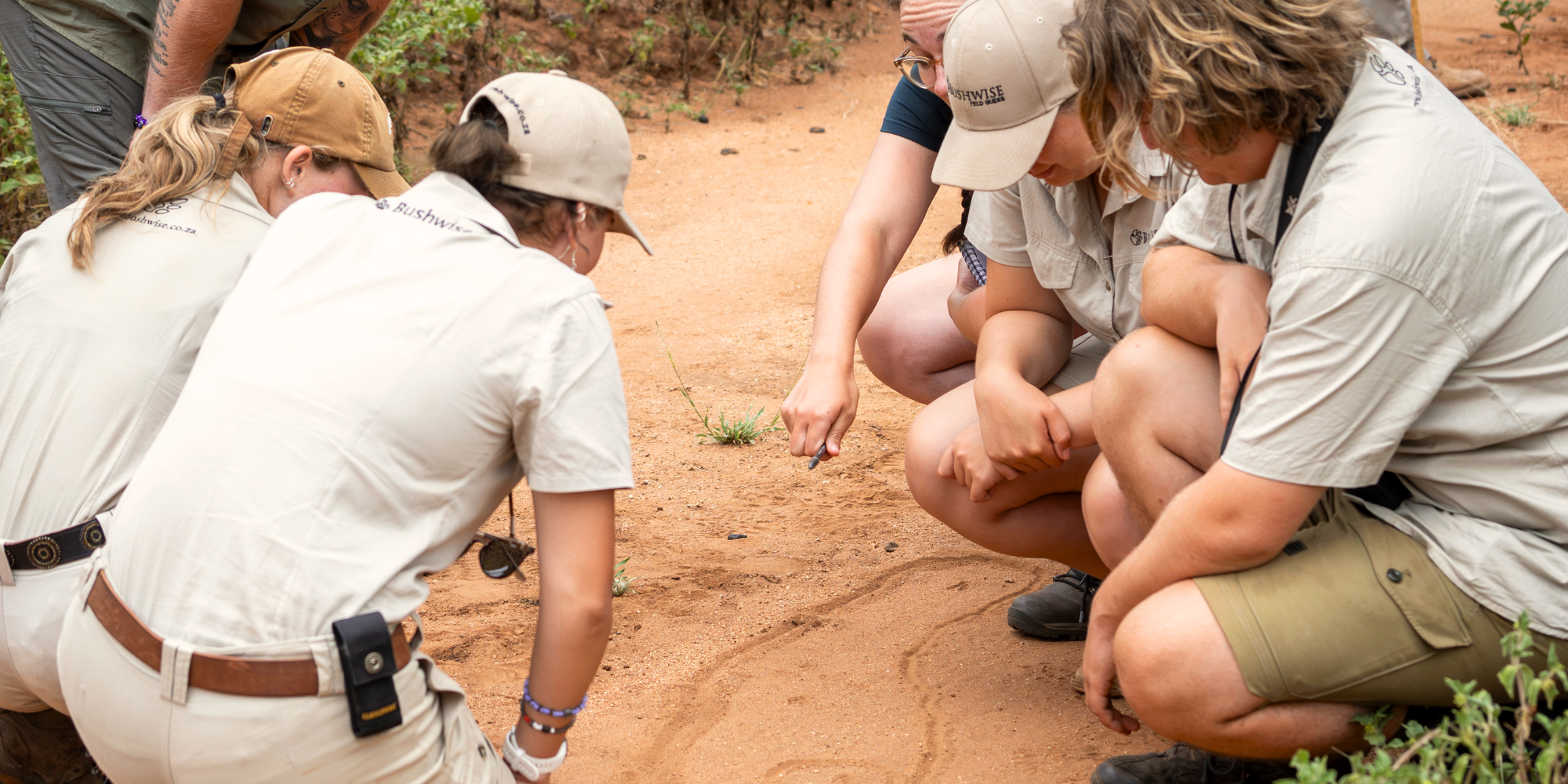
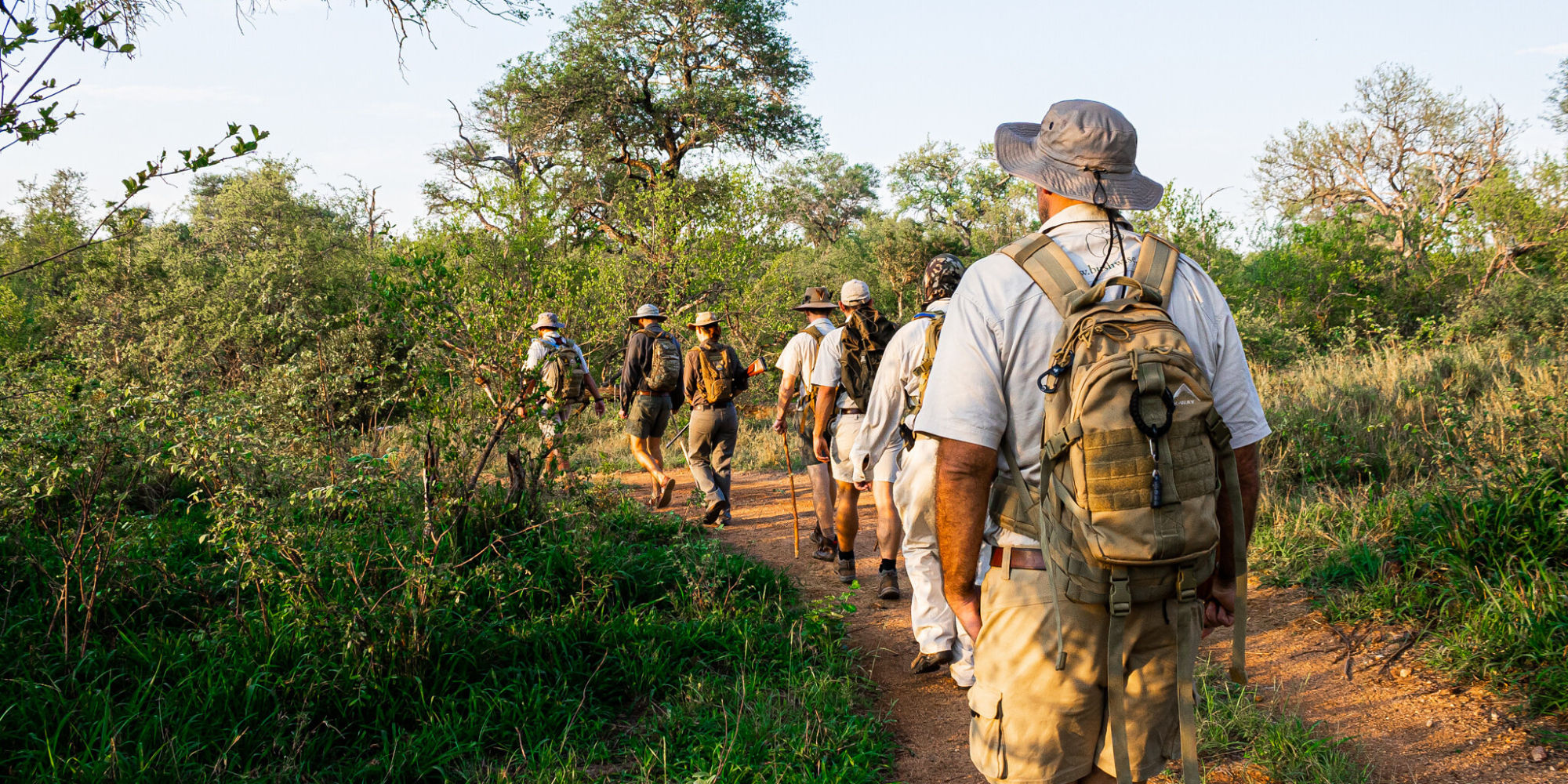
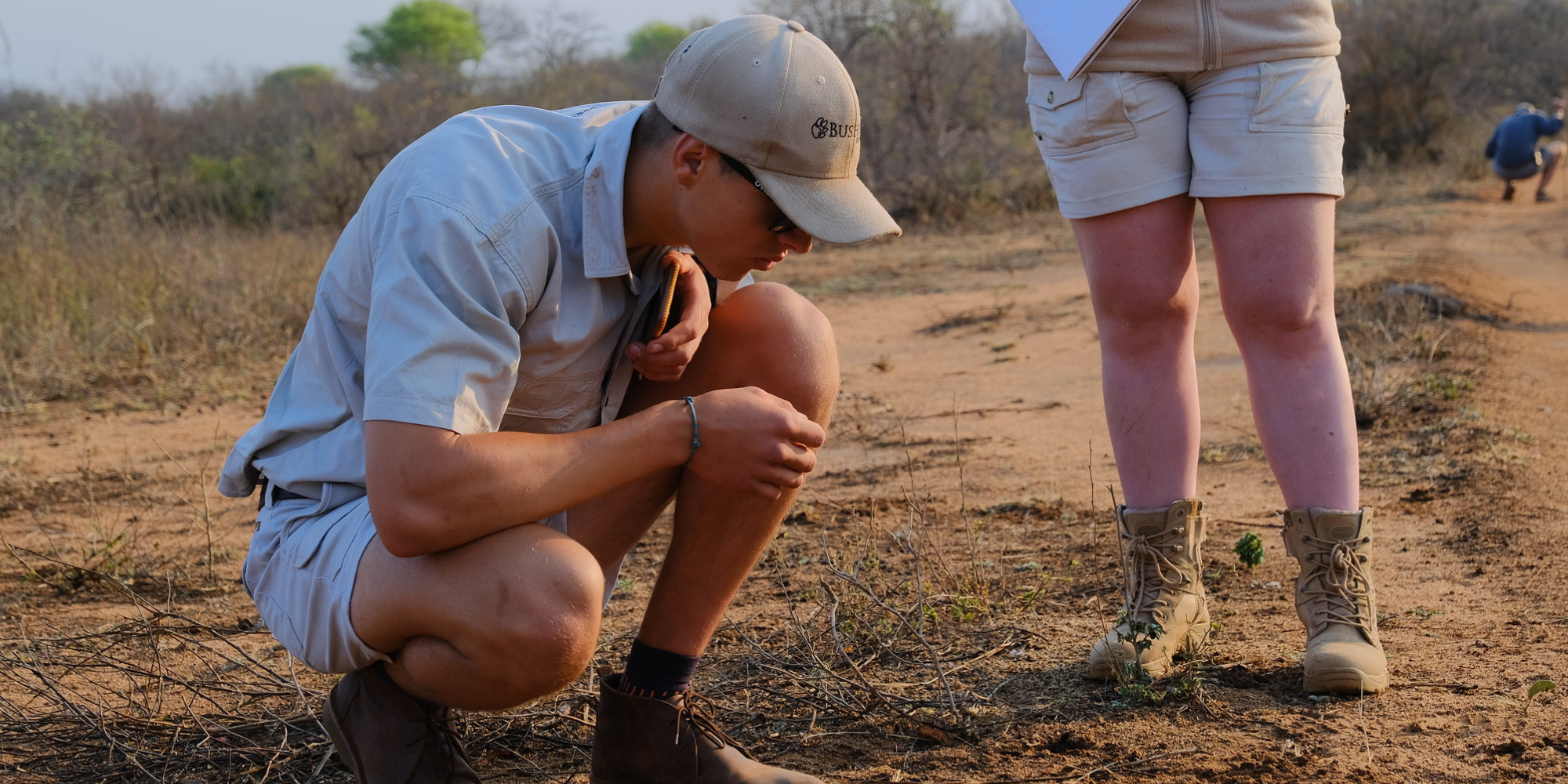
    At the start of my camp manager week, my peers and I have begun to learn the art of tracking and trailing, a skill used to track animals in the bush. Track and sign has, for me at least, opened up a new dimension to the bush. As I slowly begin to understand the story of each trail and spoor, I feel that the bush slowly begins to reveal its secrets to me. By being able to see the activity of the bush you begin to write your own story about the daily comings and goings of animals and the journey each one takes. 

    As we looked deeper into animal behaviour and the trails that each species leaves behind, I started to wonder what story has been left behind in my wake? As I trudge through the hard times and overcome the obstacles I face in my own life, I started to question what signs are guiding me to my next destination. My own life’s path is marked by signs, perhaps subtle and easily overlooked, yet each a vital turning point to reach today’s destination. 

    image

    My journey to Bushwise is a perfect example of how my own trail through life has been met with unexpected twists and turns. My decision to join Bushwise was at the very last minute. It was a choice I made one afternoon when I was having a small meltdown about what to do with my life. It was an instinctive click on an Instagram ad that has now led me to sit miles away from my past life learning how to track wildlife through the bush. Just less than 4 months ago I was at university attempting to finish up my honours research paper on perceptions of crime in urban areas, now I am spending my days traipsing through the bushveld and having naps under shady trees whilst looking out for signs of animal activity. 

    This drastic change has led to a lot of introspection in an attempt to understand how and why I ended up here. The trail I have left behind in my own personal journey is filled with twists, turns, and unexpected encounters. What seemed like an impulsive decision to venture into the bush and become a guide transformed not only my physical surroundings but the people I face every day, as well as my daily routine right down to what I eat and the clothes I wear. I am not the same person; I don’t have the same friends, nor do I live in the same place. But somehow, somewhere, there was a sign along my track that pointed me in the direction of the bush. 

    image

    When coming to Bushwise I had little to no idea what to expect, I wanted a change, a new life outside of anything I had known before. This past week trekking through the bush and discovering its secrets has shown me that taking the initial leap and joining Bushwise was a decision that I am proud of, one that has made all those sleepless nights worrying about what I would possibly do after university seem pointless, and one that makes me excited for my future. As I now reflect on my week as camp manager, I can appreciate the choices I have made leading me to where I am today. I have had an unbelievable week getting to know the bush, myself and my peers. My week as camp manager was one which placed me in a role of responsibility, but also a position that allowed me to reflect on my experience at camp so far. I have had a week filled with brand new experiences and adventures that I could have only dreamed possible before. 

    Follow your trail of self-discovery at Bushwise. Join one of our programs now.

  • The Bushwise Journey: Looking Back on Unforgettable Experiences

    This blog was written by Femke van Nieuwkerk, Bushwise Professional Field Guide student. Each student takes a turn as camp manager, and writing a blog is part of the experience.

    3 min read

    It all started on the 7th of January, when some of us arrived on time by car, others arrived together through an organised shuttle and one of us took a lovely detour to the wrong campus, but luckily ended up with us. The first day consisted of filling in forms, forms and some more forms. Keys to the tents were distributed and you got to know who was your roommate for the next 22 weeks. 

    image

    First aid training and new wildlife sightings

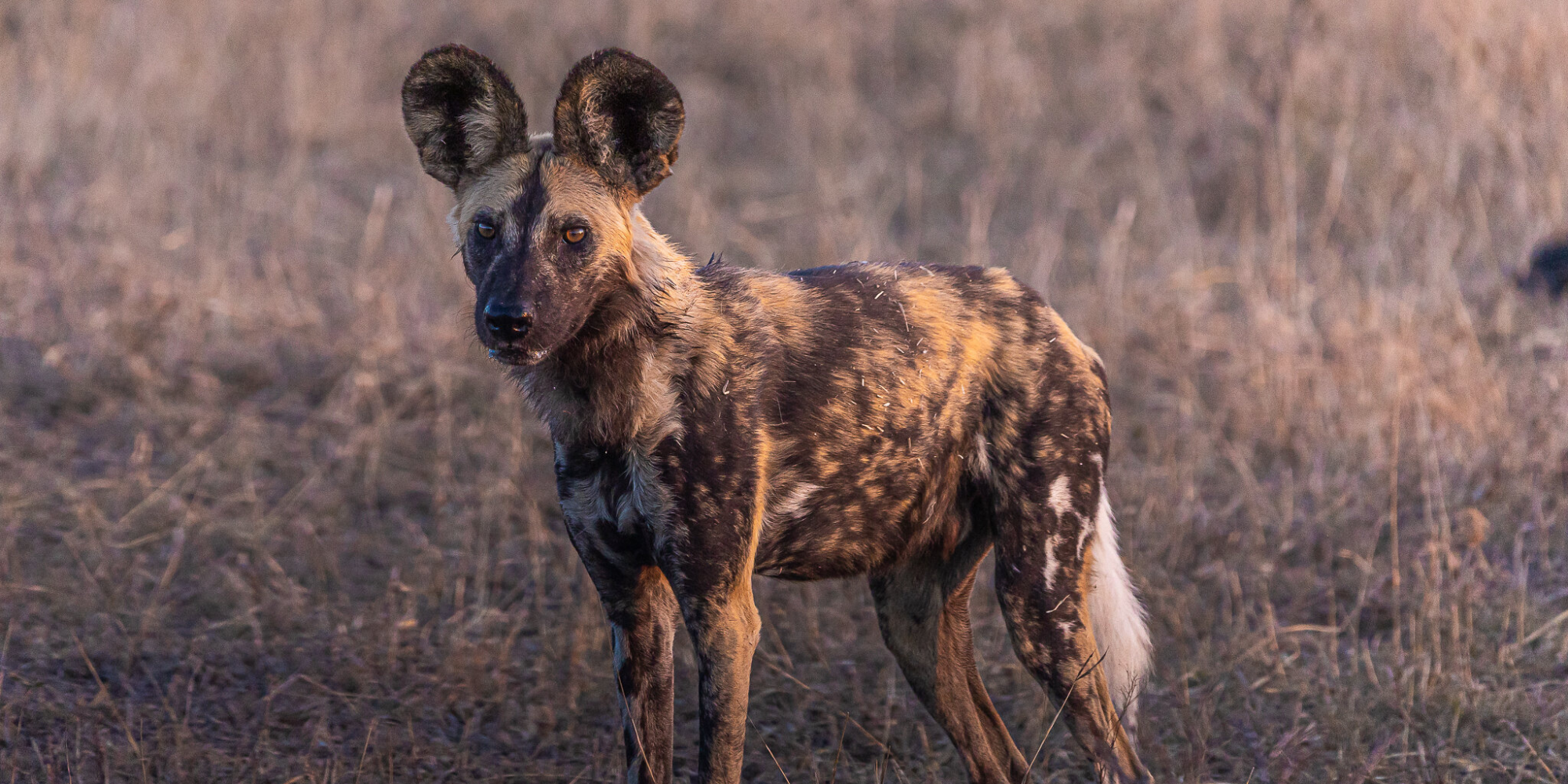
    The first week consisted of First-Aid training, seeing wild dogs and spotted hyenas at the fence line, the early beginnings of many friendships and getting our uniforms. Afterwards, we started to dig into the modules and learn all about topics such as geology, weather and climate and botany. In the meantime, we slowly started to go on game drives, where everyone had turns in driving for one hour. During the first semester real friendships formed – such as the Black Backed Puffbacks (blog of Regardt van der Westhuizen). Who would have known from the beginning that in many cases in this course, the two other random people in your tent would become such good friends?!

    After the first off-week, our big group of 31 people was split into two groups – those doing their International Field Guide Association qualification and those doing the Bushwise Professional Field Guide qualification – each with its own schedule. Where PFG had their exams on bird sights and sounds, IFGA was busy with their Track & Sign. On days that PFG had a late start, IFGA had to start early. Most of us had to get used to this difference, even some friendships got lightly tested during the first days and afterwards came out stronger than before. 

    image

    Getting into the game drives

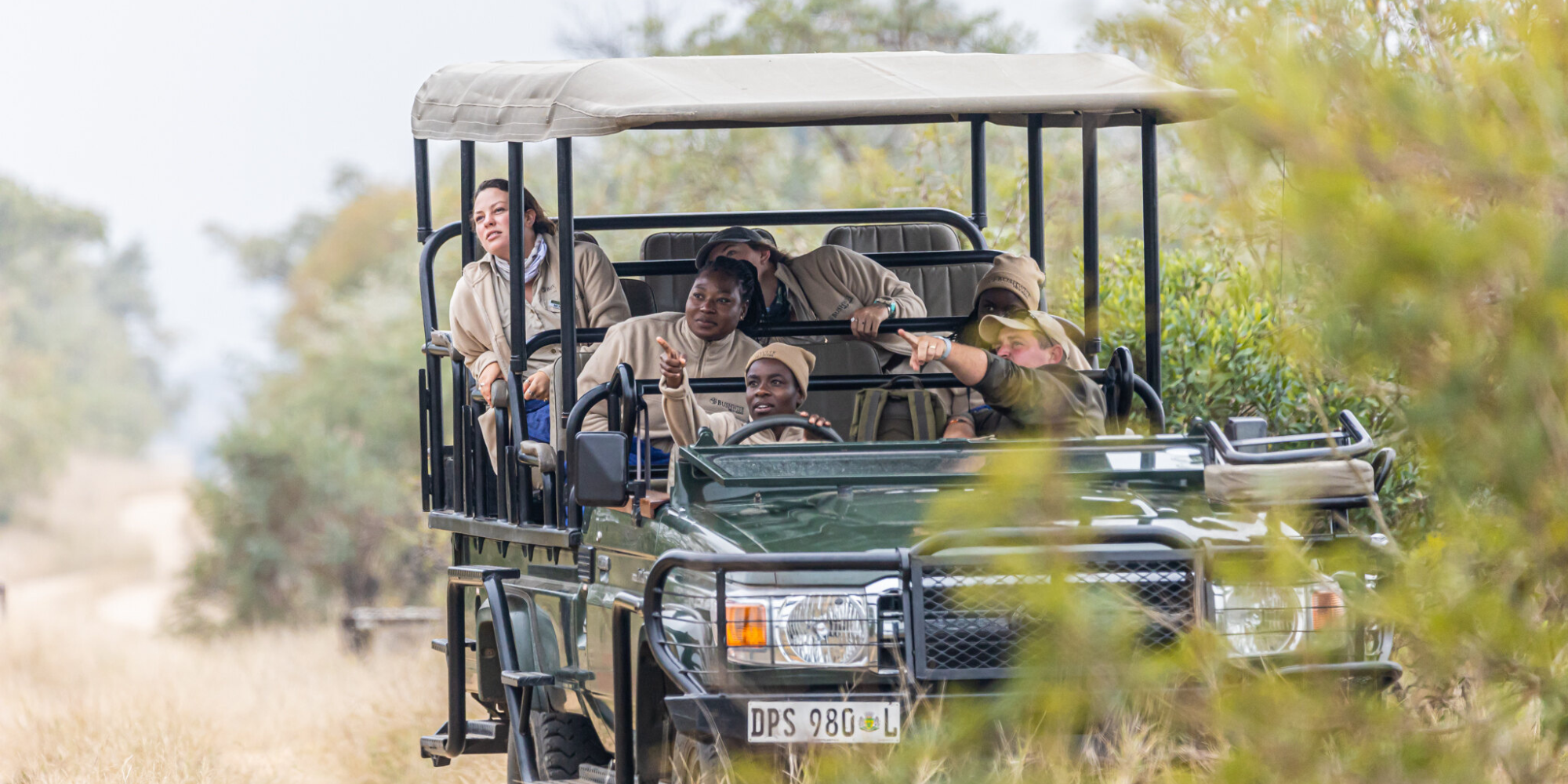
    For PFG the first three hour drives started and we got a real taste of how it feels to guide and the preparations that come with it, such as making sure the hotbox is filled, making sure that your route makes sense and doing a vehicle check. Semester two ended with the FGASA exam for all of us. As of now, we don’t have the official results back yet – but most of us feel positive about it. In my opinion, you could sense the growth in everyone during this semester, be it in becoming more professional, having better study methods, having more confidence or in becoming more open. 

    We are now two weeks into the third semester and this time it is IFGA’s turn to learn bird sounds. The PFG group had their two weeks of Track & Sign with Colin and Sam Patrick, which is considered as a highlight for most of us. As I am writing this blog, half of our group (IFGA) will leave to go to Sabi Sands for four course weeks to get experience with working in a lodge. This leads to a day which is filled with a lot of mixed emotions; saying (a teary) goodbye to each other, excitement and anxiety about what has to come and maybe even some – healthy – jealousy of the group staying at SAWC. 

    image

    Looking forward to the next steps

    For PFG the rest of semester will be about botany, bird theory, slide and sounds of all species and mock assessment drives. For IFGA it will be about birds, mock assessment drives, learning how to work in a lodge and how to effectively heat your water for your shower – as they will not have proper showers for the next four weeks (something nobody in PFG is jealous about). 

    In conclusion, we have learned vast amounts about nature, guiding and ourselves during the past months. Strong bonds have been formed, which probably only will become deeper and stronger as the time will pass on. I can only imagine how much we will learn in the next semesters, for example doing ARH and our assessment drives, but the thing I am looking the most forward to is for the IFGA group to come back and tell us all about their stories. 

    Ready to start on your own field guiding journey with Bushwise? Apply today!