Category: Course updates

  • Top tips from Industry experts for Field Guides

    “The key to being a good nature guide is the ability to create a unique guided nature experience and promote conservation. It is about combining one’s individual talents, abilities and personality with educating and entertaining guests and instilling in them an interest in all aspects of nature and ensuring that they have a richly rewarding experience. People who do well as nature guides are generally passionate about nature, enthusiastic, good communicators and get on well with people.” – Field Guides Association of Southern Africa (FGASA).

    Field Guides are the critical link between the guest and their wildlife/safari experience. As a visitor to a Game Reserve or National Park you want an overall amazing experience from the food and service to the accommodation and all important game drives. Most of the time guests are coming to see Africa’s iconic animals and unforgettable sunsets! For many, the most important aspect of a visit to the African bush are the game drives, this is where the field guide makes all the difference – tracking and spotting animals, finding the right position for the best viewing spots and photographs, being at the right place at the right time all the while explaining and giving guests interesting facts about what they are seeing, smelling & hearing. The field guide needs to be able to translate the secret language of nature and it’s intricacies for the guests, to give them a true understanding and appreciation of the wonders of the wild.

    Good communication skills are key!

    See through your guests eyes: Anticipate their wishes before they are voiced. And remember what it was like to see a giraffe for the first time.” – James Kidd, creator and editor of Ranger Diaries.

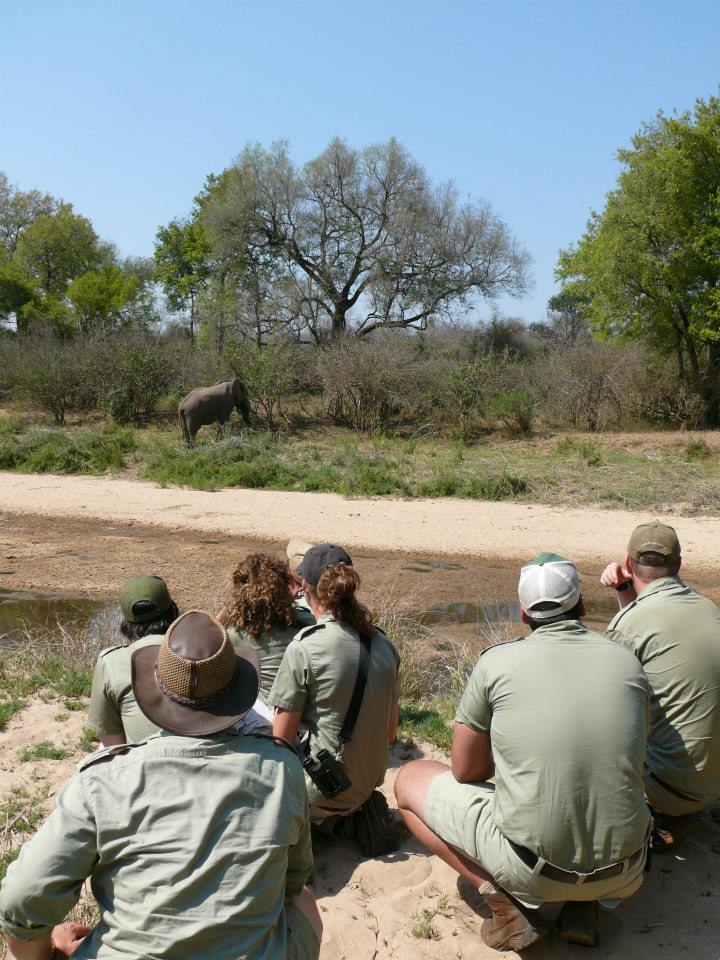
    This is an important part of gauging the expectations of your guests. The key to this is to read between the lines and pick up on bits of general conversation and interest on what they would like to see, rather than asking the obvious question ‘what would you like to see?’ Explaining certain situations, signs and interactions is also vital to the guests understanding of your reasoning and helping them to understand the environment they are in. For example, explain why it is important to not get too close to rare and / or skittish animals in case you make them uncomfortable and chase them off.
    image

    P*A*S*S*I*O*N!!!!!

    ‘Passion, passion, passion’ are what the top & most experienced Field Guides have told me is the most important attribute of a field guide when asking them what their TOP TIPS are for our up and coming field guides. In addition to passion and possibly as a symptom of it, a positive attitude and enthusiasm goes a long way. Guides can spend up to 10 hours per day with their guests and this goes a long way in creating a memorable experience. If field guides are not passionate, pleasant and enthusiastic the guests can sense this and there is nothing to ruin and amazing experience for a guest than an insincere or disinterested guide.

    Humility should be an understated and valued asset!

    “Stay humble and don’t be subservient. Be thankful for the blessing that nature allow us to enjoy every on the job we do.” – Trevor, Senior Bushwise Trainer.

    Long time safari guests often say, ‘If the guide is humble s/he will tend to listen to the guests requests. They will realize that they don’t always know everything and that they should be willing to learn new things. A stubborn, know-it-all guide will get NO TIP from us! Some guests feel obligated to give tips yet the tip should be for service above and beyond’’

    It’s all about your ATTITUDE!!!

    “Enthusiasm is one of the most important traits in a guide’s arsenal. Someone very influential in my own guiding career, many moons ago, pointed out that if you don’t show enthusiasm for the smaller things, you can’t expect your guests to be excited about it either. This applies especially when viewing or explaining the non-Big game, when big game may be scarce.” – Charles Delport, previous Head Trainer for Bushwise and now owner of Nightjar Training & Consulting.

    Knowledge is power….

    “You can never stop learning about the Natural world. Knowledge is key, so take advantage of that fact that you are in the environment on a daily basis to keep on learning and experiencing new things. If you think you know everything, then you need to stop guiding!” – Ben Coley, Bushwise Head Trainer
    image

    The Lodge industry is highly competitive and most (if not all) lodges are looking for the best guides, the guides that will make their lodge stand out. Guides who are a cut above the rest will achieve this and add so much more value to each guest’s experience.

    Find out more about Bushwise courses.

    Bush greetings from Kim & The Bushwise Team
  • The ‘PERKS’ of being a Field Guide!

    Yes, we get to live our dreams………which for most doing this rewarding job is to be surrounded by nature in all its beauty. From the animals, the lifestyle and the new people we get to meet. You get the opportunity to give guests an abundance of amazing memories and experiences they will never forget. As a Field Guide you will get to travel, live and work in some of the most breath taking wild life reserves in Africa and generally live a happy, contented life!

    image

    However, let us explore the acronym PERKS.

    P – Professionalism

    E – Enthusiasm

    R – Respect

    K – Knowledge

    S – Skills

    Quote/unquote Mark Frazer (Nostrophobic Adventures)

    From a core values viewpoint, these should be without fail, in the fore front of your mind at all times to ensure that you remain at the top of your game and a much sought after Field Guide throughout your guiding career! Quite simply put, these are your foundation and building blocks.

    Without belabouring the point however, we at Bushwise Field Guides strive throughout the course to instil these foundations on an ongoing basis, and thus would simply like to share from the Bushwise team some of the SKILLS that we have gained over the past few workshops we as Trainers have attended, in order to strengthen you as future field guides in becoming the PROFESSIONALS you already are. After all your ENTHUSIASM, RESPECT for the environment, and KNOWLEDGE is abundantly evident and thus the acronym PERKS is validated.

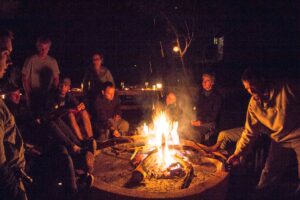
    Before I continue though, it is important to remind yourselves that you are a narrator, a story teller if you wish….. after all, how many of you have sat around a campfire, mesmerized by the stories of the older generation of ‘game rangers’ recounting their experiences and adventures in the African bush and not been left with a longing to be able to do the same and experience those same adventures?

    image

    The key here of course, is to remember to tell a story, in doing so, you are engaging your guests all the time through the means of your body language, maintaining eye contact (without sunglasses on remember), maintaining your presence by using the sound of your voice, creating energy with hand and body movements, using a little light humour and above all……., enjoy what you are doing since that is part and parcel of the ENTHUSIASM aspect of a successful and competent Field Guide!

    In closing, this week sees the end of a long, somewhat physically tiring second semester which included the 4×4 training course, Cyber tracker ‘Track & Sign’ course, trips into the Kruger National Park, some Firearm practice as well as the ongoing solo game drives done by students. Thus I am sure it is a most welcome break for the students to enjoy a little Rest and Relaxation!

    image
    image

    Have fun Guys and Girls, and whatever your plans are, keep safe and we look forward to seeing you in the Third semester.

    Trevor and the Bushwise team

  • The long awaited rain finally arrives!

    This last week was one which started off with hard work, as the students studied and got to terms with two very dynamic aspects of our region, namely Astronomy and Geology. The classes were entertaining though, as trainers took the students down a virtual exploration, from the depths of the Earth’s crust, to the galaxies and beyond! All this time, the clouds were brewing beyond the distant mountains, and the smell of long awaited rain became ever more present!

    image

    After some serious studies, the students went on a day’s trip to Kruger, as well as a full day drive on Makalali, where they could start practising the real deal, leading a guided Safari! With the knowledge they have been absorbing over the last weeks, this was the time to brag with what they have learned, and the skills they had developed thus far. The transformation from when they first started the course till now was very rewarding for the trainers, and the students performed amazingly, with us often forgetting that these students have only been with us for two months!

    Some epic

    sightings have been had on the reserves lately, as we encountered Hyena, Cheetah, Lions and Elephants, along with plenty of general game, and the spaces in between filled with a multitude of birds and other interesting elements of nature! Little did we know though, that we would be treated to the first proper rains of the season this week!

    There is certainly something special about the smell of rain after many months of drought, and when the heavens decided to eventually open, everything, including the students rejoiced! This ended in a lot of soaked, muddy, but most importantly happy students, who have come to appreciate the importance and necessity of rain! A lot of white Bushwise T-shirts, will never be the same again, but none the less, a special moment among the team!

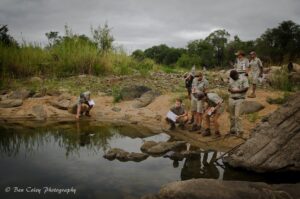
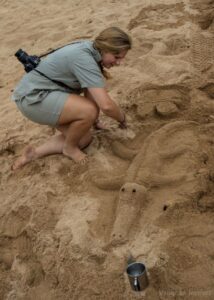
    The following morning we headed off on drive, and witnessed quite a fascinating occurrence as the Makutsi River started flowing again! We spent most of the morning watching the water creeping along the dry sand, slowly at first as it soaked in, then speeding up and covering ground, greeting the parched dry river sand section by section, bubbling along. Some students made a few little sand sculptures as they waited, whilst others had fun trying to catch the first eager catfish (Barbel) that were swimming in the pools, which only moments back did not have any water!

    The week ended off with exams as usual, as they knowledge passed down during the week was tested. Most of the students did exceptionally well, and are eagerly awaiting the upcoming week where we continue with the assessment safari drives and add more to their experiences which they will need to become great field guides!

    image
  • Spotted Bush Snake enjoys a frog for breakfast…

    With the end of winter drawing close and spring in full start, the anticipation of a facelift for the bush in general is the main talking point at the moment.  As the temperatures are slowly increasing, our cold blooded friends are starting to show face, with an increasing amount of “snake trails” that can be seen crossing the roads and one of our resident spotted bush snakes around the campus peeping out its head out of it crevices where he had been lying dormant for the winter. A few students had unexpected surprises whilst studying in the lecture room and all of the sudden a snake passing by their feet or eye level.

    Whilst doing a lecture last semester, the students hear a rather disturbing call and with further investigation came across the snake catching a foam nest frog for breakfast.

    The Spotted Bush snake is harmless (well at least to humans) because it does not have any venom glands.  This arboreal (tree living) snake employs a different method catching its prey. The Spotted Bush snake will keep dead still and waits patiently for an unwary skink or frog to pass by; it then lashes out at the speed of light and catches the prey item with a mouth full of needle sharp teeth. It sometime uses constrictor methods to crash bones or makes its prey easier to swallow.  The prey item is then encircled by the coiling motion of the snake’s body, which clinches tighter and tighter every time the prey exhales. It is only a matter of time before the inevitable is achieved and the prey is swallowed whole, usually with the head first to avoid one of the limbs causing a blockage.

    This method of catching prey is also employed by Southern Africa’s largest snake, the African Rock Python which can get up to 6 meters. It is an excellent climber and can be found in bushes, trees, on walls or even gliding in between the cracks of bricks. When this snake is disturbed, it will move away fast and in short bursts to the nearest cover. If it is cornered or when it turns defensive, it will inflate its neck like some other snakes and the blue skin in between the scales will be visible. This makes it look more dangerous, almost like a Boomslang. It bites readily if you try to catch it.

    This snake is almost always mistaken for a Boomslang. Although there are many differences, they both can be seen in trees and both are green. The spotted bush snake is harmless to humans, but often killed by us, because of this confusion

    The Spotted bush snake is a very pretty snake; it is a bright green colour with black dots from the head all the way down the body for about two thirds of the body length. The last section of the snake towards the tail fades from a bright green to a blue/purple colour.

    Always keep your eyes open for the small creatures that the bush often keeps hidden!

    Find out more about Bushwise Courses.

  • Capturing the Good Times

    As you might have guessed from the title of this blog – the start of this week was purely dedicated to learning all about photography, photographic techniques and how to guide guests who are photographers. Sean Patrick, co-author of “Game Ranger in your Backpack”, conducted the two day workshop for our Grietjie Campus, whilst well know photographic guide, Albie Venter of Africa-Unlocked, conducted the course for the Mahlahla Campus.

    Both well-known photographers provided invaluable lessons to our students about all the tricks of the trade to get ‘that special shot’ (mainly by making use of all those lesser known settings & buttons on everyone’s camera!).  They also covered the importance of understanding how to guide photographers in today’s day and age. After everything from aperture, ISO, Shutter speed, exposure compensation to composition and lighting was explained – our students quickly moved away from that simple auto option and their latest batch of photos are certainly demonstrating this!

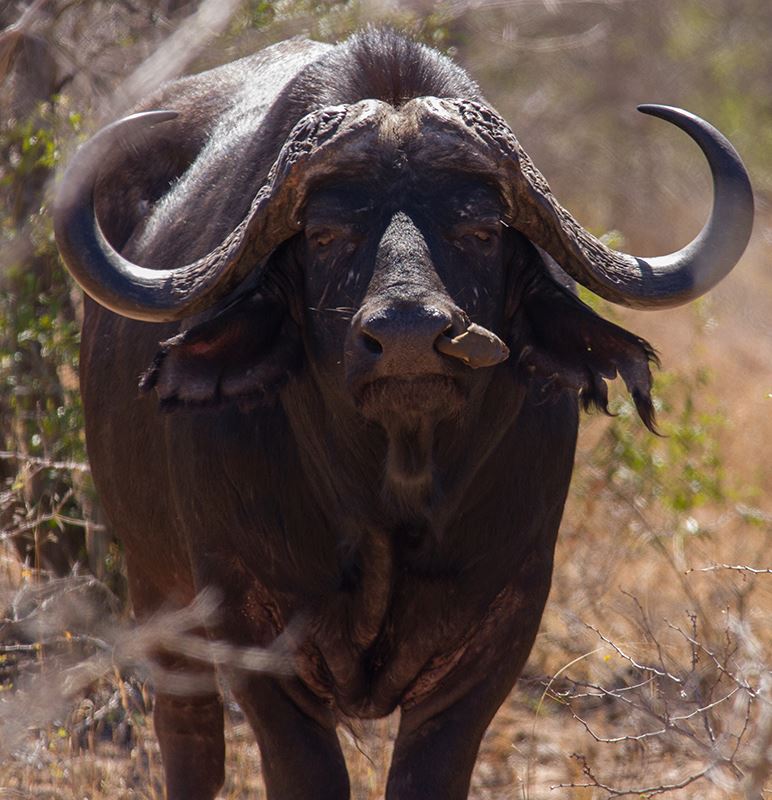
    Having spent time in the lecture room discussing the various techniques it was time to go out there and try and get some photos. Everything from Kite spiders and blades of grass to elephants, grumpy lions and hyenas were photographed during the practical sessions. Comparisons were made afterwards, with some more helpful hints from the experts. All in in all, a fantastic photographic workshop, which we were all sad to see come to an end.

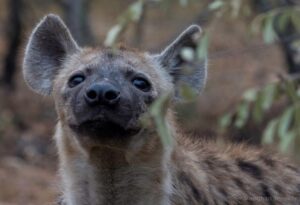
    On Wednesday it was business as usual with various lectures covered, including Taxonomy & Ecology. Later on in the day, the Mahlahla Group headed out on their first bush sleepout, which also had a planned Survival & Navigation lecture and practical. Although most people are on edge on their first sleepout on a Big 5 reserve – the only visitor was a curious spotted hyena who quickly moved off when he was spotted (excuse the pun)!

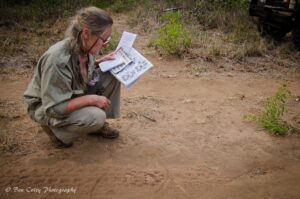
    Meanwhile, back at the Grietjie campus, Thursday morning started off with a walk. Tracking and spoor identification was on the agenda and the walk began with tracks of 2 buffalo as well as a male lion that had been drinking at the waterhole sometime during the night. The highlight came with Sunil spotting a honey badger, but unfortunately it moved off too quickly and no-one else got to see it.

    Whilst the Mahlahla group headed back from their sleepout and got ready for their afternoon drive, the Grietjie group left for the Amarula Lapa for a light lunch and tour of the factory where the underrated Marula fruit is processed, before being shipped to the Cape to turn into one of South Africa’s most famous alcoholic liqueurs….Amarula Cream. The students had the opportunity to try out various cocktails and food dishes which had been made with Amarula cream. The fruit is such a versatile item in the bush and there are so many products which can be made from it, it was interesting to watch the process for just one of its many uses.

    Tomorrow marks the last set of tests for the first Semester! Our students then head off on a well-deserved week off, with plans which include visits Kruger, Cape Town and Mozambique! Enjoy ladies and gents, see you soon!

    Until Next Time,

    The Bushwise Team

    (Thanks to Jacques Briam and Adam Mohr for use of your pics!)

    Find out more about Bushwise Courses.

  • Welcome!

    This week saw us kicking off with a very eagerly awaited new group. There are a lot of exciting plans for this group, such as the addition of not just one, but two extra reserves for our practicals! As the saying goes, variety is the spice of life and with the new areas, comes more diversity in animal sightings! This course we also wish to welcome a new, and now fourth Trainer to our team, Cobus Spies. Cobus is a FGASA level 3, back-up trails guide and is also a FGASA assessor. With his past training experience and passion to the smaller things around, we are certain he will add to the quality of our training courses, welcome Cobus!

    On the student front, welcome to each and every one of you, we hope you grab this opportunity with both hands, and make the most of what we have been told by past students time and time again, is a life changing experience! Welcome to Lawrence, Shawn, Nuria, Sean, Debbie and Matt from South Africa; Ben & Tina from Germany; James from Ireland; Mayra and Frank from the Netherlands; Macon, CJ and Hayley from the U.S.A; Vitor from Wales; Andrew, Kate, Emma and Ash from the U.K and finally Anna-Marie from Australia. A diverse group of nationalities always makes for a more interesting learning experience and we look forward to getting to you know all better.

    After the majority of our students arrived at around 5.30pm on Monday, the order of the evening was to do a brief welcome, explanation and H&S chat, after a delicious meal cooked by Iris of course! Tuesday came round and the usually H&S, camp walk through, explanation of the course itinerary etc was presented, with the afternoon set out for handing out the Bushwise clothing packs and a welcome Braai, where we got to know each other a bit better.

    Three days into the course, we had our usual town trip to equip our students with the ever necessary, and popular, khaki uniforms. On our way back from town, one of the groups were fortunate enough to spot 4 cheetahs, two being on the reserve we were heading to for our first game drives! Knowing roughly where they were, we knew we were in for a good sighting! Roughly 15 minutes into our drive, we saw 2 animals walking down the road, and as we approached, the silhouettes developed spots, and there they were, walking into the wind, and at quite a pace until they veered off the road and started disappearing into the long grass. It was clear that they were hunting, and before long, disappeared. What a way to start your first ever drive! As it started getting darker, we had our usual drinks break, for one of our groups, this was briefly interrupted by a rather big female hyena! Other groups also had nice views of some of those secretive animals such as porcupine, and everybody’s favourite…… Honey badger!

    During the latter parts of the week students all completed the very vital First aid qualification, had a lecture on the guiding industry and an introduction to the guiding world, which was followed with another game drive that produced some great sightings of general game including sable, porcupine and some bushbabies!

    This morning continues with a lecture on VPDCritters – getting to know all the creepy crawlies which may have a bit of a bite!

    After a very busy first week, we can only look forward to a possibly even busier second week!

    Regards,

    Charles and the Bushwise team!