Author: Bushwise

  • A guide to the Common String-of-Stars

    On a late-summer morning in the lowveld, you might spot a patch of delicate white flowers curling along sandy paths, almost like a string of tiny stars. Stop and look closely – this is the common string-of-stars, Heliotropium steudneri, a modest but fascinating plant that often goes unnoticed!

    The common string-of-stars is a perennial herb or subshrub, usually 60–100 cm tall. It’s woody at the base, with softly hairy stems and narrow, alternate leaves. Its signature feature is the coiled, elongated clusters of small, star-shaped flowers that slowly unfurl as they bloom. From a distance, it may seem unremarkable, but up close, the pattern and symmetry of each flower spike show just how beautifully adapted this plant is to its environment.

    This species is widely distributed across eastern and southern Africa, from Eritrea and Ethiopia down to South Africa, and even across the Red Sea into Yemen and Oman. It thrives in open, sandy soils, dry bushveld, and shrublands, often appearing in disturbed areas or along roadsides. After seasonal rains, it bursts into flower, adding subtle life and colour to otherwise dry landscapes.

    From a conservation and ecological perspective, the common string-of-stars is a pioneer species. It often colonises sandy, disturbed soils first, stabilising the ground and creating opportunities for other plants to establish. For wildlife, its flowers provide nectar for insects, supporting pollinator networks that ripple through the ecosystem. In this way, even a small plant like the string-of-stars contributes to the larger web of life on a reserve.
    For Bushwise students and safari guides, recognising flower species isn’t about identification alone – it’s really about understanding the veld. Knowing which plants signal recovery, which provide resources for insects, and which require careful handling is part of developing the observational skills that make a guide truly exceptional. It’s also a reminder that every element, from the tiniest flower to the largest tree, plays a role in the ecosystem’s health.
    Next time you walk a trail or drive a sandy road, take a moment to spot the coiled white spikes of Heliotropium steudneri. Pause, study its flowers, notice how they catch the light – and think about the quiet but essential role it plays in the bush. It won’t dominate your photographs or headlines, but it’s one of those species that teaches patience, observation, and respect for the African bush.
    If you want to learn about the small wonders of the African bush, Bushwise Wildlife Courses  give you hands-on experience identifying plants, tracking wildlife, and understanding ecosystems from the ground up.
  • 10 ways the IFGA App could change the game for guides

    Let’s be honest: field guiding is one of the most rewarding careers in the world. But building a successful long-term career in the industry hasn’t always been straightforward.

    For most guides, there hasn’t been a clear way to track their professional growth, showcase experience, or stand out in an increasingly competitive job market. While guides have worked hard to develop their skills, the tools needed to manage and advance their careers simply haven’t kept pace.

    The International Field Guide Association (IFGA) has launched its free IFGA App to solve this challenge for guides and the broader industry as a whole.

    Whether you’re currently studying with Bushwise, already working in the industry, or looking to take the next step in your career, here are 10 ways the IFGA App could make life a whole lot easier:

    1. Build your professional profile from day one

    Most guides spend years building experience before they have a clear way to showcase it.

    With the IFGA App, you can start creating a professional profile on your phone while you’re still training on campus, helping you document all your milestones to demonstrate your growth over time.

    2. No more paper logbooks

    If you’ve ever had to dig through notebooks looking for hours, species records, or licence information, you’ll appreciate this one.

    The app allows you to log and store your experience digitally, keeping everything organised and easily accessible.

    3. Your achievements are all in one place

    Qualifications, licences, logged hours, certifications and career milestones can all live within a single platform.

    Instead of managing multiple records, you’ll have one professional profile that grows with your career.

    4. It becomes easier for employers to find you

    Landing your next opportunity often comes down to visibility.

    The IFGA App allows guides to create professional profiles that can be viewed by recruiters and employers looking for qualified talent, helping you get noticed by the right people.

    5. You can see how you’re progressing

    One of the biggest challenges in any career is knowing where you stand.

    Through IFGA assessments, certifications, and global live leaderboards, guides can benchmark their progress and work towards clear professional goals.

    6. There’s a pathway beyond your first guiding job

    The app supports progression through different levels, including IFGA Guide, IFGA Advanced Guide, IFGA Ambassador, and the specialised Head Guide Certificate.
    In other words, it’s not just about getting into the industry – it’s about building a long-term career within it.

    7. Different doors can open

    Not every guide wants the same career path.

    Whether you’re interested in lodge work, freelancing, private guiding, or eventually moving into management, the platform helps create greater visibility and access to opportunities.

    8. Head guides get better tools too
    The benefits don’t stop with individual guides.
    Head guides can use the platform to monitor compliance, track licences, manage teams, and keep important information organised in one place.

    9. Less admin means more time doing what matters

    Let’s face it: nobody gets into guiding because they love paperwork.

    By digitising many of the administrative tasks that guides and lodges deal with every day, the app helps reduce unnecessary admin and simplify daily operations.

    10. It brings the industry together – for free

    Perhaps the most exciting part is that the app creates a shared ecosystem for students, guides, assessors, recruiters, and lodges.

    Instead of everyone working in separate systems, the industry becomes more connected, transparent, and accessible.

    An exciting future for guiding

    The IFGA App isn’t trying to change what makes guiding special.
    Great guiding will always come down to people, passion, conservation, and unforgettable guest experiences.

    What the app does offer is a modern way to support those things — helping guides build stronger careers, helping lodges operate more efficiently, and helping the industry move forward together.

    Best of all, both IFGA membership and the app are completely free.

    Whether you’re just starting your journey with Bushwise or you’re already an experienced professional, now is the perfect time to see what the future of guiding looks like.

    Ready to explore?

  • The path to becoming a Professional Safari Guide

    Few careers make you feel as alive as field guiding. It’s a job where your office changes with the sunrise, your meetings happen around a fire under the stars, and your “daily routine” might include tracking elephants, listening to lions calling in the distance, and sharing stories with guests who are experiencing the African bush for the first time.

    But behind the magic, there is a clear professional pathway built on training, qualifications, and experience.

    What qualifications do you actually need to guide?

    The main question new guides have is figuring out what they must have to work legally, versus what is just optional. To work as a professional guide in South Africa, you only need to tick one official government box: you have to hold a qualification accredited by CATHSSETA (the culture and tourism sector training authority).

    This is really where the journey begins. It’s the essential foundation that teaches you how to move safely in wild spaces, understand the basics of ecology, and start interpreting the natural world for your guests.

    Where do field guide associations fit in?
    Groups like the International Field Guiding Association (IFGA) and the Field Guides Association of South Africa (FGASA) are separate, voluntary industry bodies. Joining an association is a personal or professional choice, not a legal rule. They exist to offer guides extra industry recognition, field grading, and career development paths, but they do not replace or override the government’s legal baseline.

    Understanding the NQF Levels

    When you look at CATHSSETA-accredited courses, you’ll see them broken down by National Qualifications Framework (NQF) levels. Think of these simply as milestones as you gain experience in your career.

    NQF Level 2 (Nature Site Guide): This is your official starting point. It is the baseline certificate that gets your foot in the door, lets you register with the government, and allows you to start working at a lodge. Your training here is all about moving safely in wild spaces, learning basic ecology, and figuring out how to explain the bush to guests.

    NQF Level 4 (Advanced Nature Site Guide): This is a higher level designed for senior guides. It recognises deeper field knowledge and better guiding skills. Crucially, you cannot skip straight to this level; you can only take your NQF4 assessment after you have finished a full year of active, hands-on guiding experience out in the field.

    The Path to Walking Safaris (Trails Guiding)

    For a lot of guides, the ultimate goal is to take guests out on foot. To do this safely in areas with iconic wildlife like the Big 5, you need a trails guiding certification.

    Step 1: Foundational Trails Guide: This is where you learn how walking safaris work. At this stage, you do not lead walks by yourself – you assist an Advanced Trails guide. The focus here is on building your awareness and learning to walk in a Big 5 environment, safely.

    Step 2: Advanced Trails Guide: Once you have logged your foundational hours and ticked all the boxes, you can take an assessment to qualify to lead walks independently. At this level, you take full responsibility for guiding guests on foot through big game territory.

    You can learn more about the different stages here.

    Where IFGA fits in

    Working alongside CATHSSETA qualifications, IFGA certification adds another powerful, but voluntary, layer to a guiding career. This certification focuses on what makes a safari truly unforgettable: the guest experience.

    It develops skills like:

    • Storytelling that brings the bush to life
    • Reading guests and adapting to different personalities
    • Communicating with confidence and warmth
    • Creating a sense of connection, comfort, and wonder
    • Elevating every moment, from game drives to dinner conversations

    It’s the difference between a guide who is qualified and a guide who truly leaves a lasting impression.

    Field guiding is a profession built on knowledge, but powered by feeling.

    It’s early mornings when the bush is still quiet, the excitement of fresh tracks in the sand, and that moment of silence when guests see wildlife up close for the first time. And just as importantly, it is shared dinners, stories around the fire under the stars, and the feeling that every day in the bush brings something new.

    If you want to become a professional safari guide, Bushwise offers a range of accredited field guide courses from 2, 3, 6, and 12 months, designed to kickstart your career in the wild.

  • A guide to canine anti-poaching units

    A guide to canine anti-poaching units

    Canine anti-poaching units are working dog teams used in conservation areas to support law enforcement and wildlife protection operations. They are deployed in anti-poaching, tracking, and detection roles to help rangers locate suspects, recover illegal items, and secure protected areas more efficiently than human teams alone.

    These units consist of a trained handler and a working dog. The most commonly used breeds include Belgian Malinois, German Shepherds, and Bloodhounds. Each dog is selected based on physical ability, temperament, and drive to work under pressure.

    Training starts at a young age and is highly structured. Dogs are trained in obedience first, then developed into either tracking or detection roles depending on aptitude. Tracking dogs are trained to follow human scent over long distances. Detection dogs are trained to identify specific target scents such as firearms, ammunition, or wildlife products like ivory or rhino horn.

    Tracking dogs work by following scent trails left by people moving through the environment. These scent particles are deposited on vegetation, soil, and surfaces as a person moves. Factors such as wind, temperature, terrain, and time affect how strong or dispersed a trail is. A trained dog is able to distinguish the target scent from other environmental smells and follow it with high accuracy.
    Handlers guide the process by interpreting the dog’s behaviour. Changes in speed, direction, and focus indicate whether the scent is strong or weakening. This allows the team to adjust strategy in real time during a track.

    Detection dogs are used in more controlled operational settings such as vehicle checkpoints, ranger posts, airports within conservation areas, and entry gates. Their role is to quickly search people, bags, vehicles, or buildings for specific contraband. This significantly reduces search time compared to manual inspection and improves detection rates.
    In many reserves, detection dogs are also used for preventative security. Their presence at access points reduces the likelihood of illegal items entering protected areas.

    Canine units are typically deployed as part of a wider anti-poaching strategy that includes field rangers, intelligence gathering, surveillance technology, and rapid response teams. When an incident occurs, a tracking dog is often one of the first assets deployed to follow a suspect’s route from the point of entry or crime scene.
    Their value is operational efficiency. A dog can follow a track that may take human teams much longer to identify or interpret. This reduces response time, which is critical in anti-poaching work where delays often result in loss of evidence or escape of suspects.
    For conservation operations and training environments, canine units are a practical tool rather than a supplementary one. They improve detection capability, tracking accuracy, and overall response effectiveness in the field.
    If you want to get into the world of conservation, Bushwise offers wildlife courses that range from conservation to game management,  field guiding, and more.
  • Bushwise Launches New Practical Game Management Course

    For Aspiring Wildlife Professionals

    Bushwise, a leader in safari guide training and professional development in the wildlife tourism sector, has announced the launch of its Practical Game Management Course – a program designed for individuals wanting to work behind the scenes in reserve and wildlife operations.

    Set to begin on 7 January 2026, the course offers both 6- and 12-month options and provides students with the opportunity to gain hands-on experience in multiple areas such as wildlife monitoring, habitat management, anti-poaching support, lodge operations, and more.

    “We’ve had countless people ask us over the years: ‘What about those of us who want to work on a reserve, but not necessarily become field guides?’” said Eugene Relling, Director at Bushwise. “This course is our answer – and it’s built for the doers, the hands-on learners, and the future leaders of the conservation world.”

    The Practical Game Management Course focuses on job-ready skills and immersive field-based learning, with essential theory to support all hands-on learning. Students will train at Bushwise’s Mahlahla campus in the Lowveld for six months, followed by an optional six-month practical work placement at a game reserve, game farm, or conservation organisation.

    Graduates will complete the course with a comprehensive set of industry-recognised qualifications and Bushwise certifications, including:

    • Bushwise Practical Game Management & Tourism Certificate

    • Bushwise Hospitality Workshop Certificate

    • CATHSSETA Nature Site Guide (NQF2) Qualification 

    • CyberTracker Track & Sign Certificate

    • Basic Wilderness First Aid (Unit Standard ID 119567)

    • Bushwise Advanced Rifle Handling Certificate 

    No prior academic qualifications are required to enrol – only a valid driver’s licence, a strong work ethic, and a deep love for the natural world.

    Course enquiries:

    channel@bushwise.co.za

    To learn more about Bushwise:

    www.bushwise.co.za 

  • Bushwise expands: Career & lodge services

    Bushwise, South Africa’s leading guide development specialist, has officially expanded its services. This evolution is a natural progression of Bushwise’s mission — expanding from a focus on training to now also include long-term career support for experienced guiding professionals and tailored staffing solutions for lodges across the hospitality and ecotourism industries throughout Southern Africa.

    “Training the next generation of field guides will always be at the heart of what we do,” says Eugene Relling, Director at Bushwise. “But with over 20 years of industry experience, we saw an opportunity to apply that expertise to support individuals beyond the training phase – and to help lodges build and retain skilled teams. This expansion is a natural next step.”

    New professional services:

    Professionals in the safari and hospitality space can now access a range of free and paid services through Bushwise, including:

    • Job vacancies: Professionals can browse current openings across lodges or join the Bushwise talent pool, a database of recommended candidates directly referred to lodges.

    • Skills training: Choose from a variety of targeted training programs for ongoing professional development, with industry-recognised certifications such as ARH and Trails Guide.

    • IFGA certification and booster: Guides can gain or upgrade their IFGA certification to stand out in a competitive industry.

    • Free 1:1 career advice: Individuals can access personalised, practical support from senior recruitment experts tailored to their career goals.

    Staffing solutions for lodges:

    Bushwise also offers a wide range of staffing solutions to help lodges maintain excellent service levels:

    • Permanent and short-term recruitment: Bushwise sources high-quality candidates for seasonal or permanent roles, ensuring lodges are supported during peak seasons or staff shortages.

    • On-site training: Lodges can upskill their teams with customised, on-site training without disrupting daily operations.

    • Graduate placements: Lodges can trial candidates for six months, assessing their suitability with no commitments or risks.

    • IFGA assessments: Lodges can enhance their guest experience by certifying their teams with IFGA, which focuses on both soft skills and technical knowledge.

    • Fractional head guide: Fractional head guides provide mentorship, performance analysis, and more to elevate lodge teams. Lodges can access their expert guidance without full-time commitments.

    • Guide Academy: A community-driven model that allows lodges to develop their own talent pipeline, contributing to local communities, with the added benefit of tax-deductible contributions.

    • All-in-one solution: A year-round, all-encompassing staffing solution that meets the dynamic needs of a lodge through a predictable subscription model.

    • Complimentary team audit: Lodges can book a free, no-strings-attached audit to assess their team’s strengths and areas for growth, with actionable recommendations.

    “Exceptional people create unforgettable experiences,” adds Eugene Relling. “We want to help great staff become exceptional – and help lodges find them, and keep them.”

    To learn more or take advantage of Bushwise’s new services, visit:

    Lodge staffing solutions

    Industry professionals

    About Bushwise

    With over 20 years of experience, Bushwise is South Africa’s leading field guide training provider and the exclusive IFGA training partner in Southern Africa. Through its CATHSSETA-accredited programmes, Bushwise has built a reputation for developing world-class guides. With its expanded offering, the organisation now serves as a strategic career partner and end-to-end staffing solution for the safari and hospitality industries.

    For recruitment or career-related enquiries:

    Ryan Cousins — Head of Recruitment

    ryan.cousins@bushwise.co.za 

    For media or general enquiries:

    Eugene Relling — Director

    eugene@bushwise.co.za 

  • Bushwise and Sabi Sabi

    Launch Ranger Academy to Empower Local Communities and Foster Education

    Bushwise Field Guides and the Sabi Sabi Collection are proud to announce a new initiative to train the next generation of field guides through the Sabi Sabi Ranger Academy in South Africa’s Greater Kruger National Park. This initiative will sponsor students from local rural communities to complete field guide training, equipping them with valuable skills and providing them with career opportunities.

    Starting in July 2024, Bushwise will train aspiring field guides from South Africa at Greg’s Camp within Sabi Sabi Private Game Reserve. The Sabi Sabi Foundation and their community development partner the Gillespie Foundation will sponsor eight students per year from local communities in each training group, beginning with four students this July. This initiative unites two organisations committed to community development and conservation, enhancing career opportunities and offering an immersive ranger training experience.

    Bushwise will train candidates according to the International Field Guide Association (IFGA) standards and CATHSSETA requirements. Students will undergo six months of formal training, followed by a six-month work placement in South Africa or internationally. Upon graduation, our goal is that these newly qualified field guides will be recruited by Sabi Sabi or other luxury lodges.

    Sabi Sabi and Bushwise are dedicated to instilling community and conservation values in future guiding generations. The pandemic and other global events underscored the critical role of local tourism in conservation and highlighted the dependence of game reserves on neighbouring communities for sustainable initiatives. The Sabi Sabi Ranger Academy is a key step in these organisations’ mission to respect culture and history and conserve the land for the future.

    Bushwise is the leading field guide training provider in South Africa. It is the exclusive IFGA training provider in Southern Africa and consistently produces world-class guides through its CATHSSETA accredited courses.

    Sabi Sabi has provided life-changing experiences to guests and residents alike since 1979. They have built a world-renowned guiding team, offering holistic experiences in the bush. As Sabi Sabi expands into the Sabi Sabi Collection, they recognise the importance of growing from within and providing a platform for the next generation of rangers, trackers, and conservationists.

    Media Enquiries: Annie DuPre (annie.dupre@gviprograms.com) and Jacques Smit (smit@sabisabi.com)

    gallery imagegallery image

  • How to become a Nature Site Guide (NQF2)

    Curious how you can become a CATHSSETA Nature Site Guide (NQF2), also known as field guide?

    Field guiding is one of the most rewarding and fascinating careers you can pursue. Spending every day outside, learning about our natural world and sharing your knowledge with guests. Of course it’s not always easy – this is a career after all – but it is so rewarding. If you’re interested in becoming a qualified field guide, or safari guide, this blog should help explain the process.

    What kinds of standards exist for field guiding?

    To start, field guiding in South Africa is standardised by CATHSSETA (Culture, Art, Tourism, Hospitality, and Sport Sector Education and Training Authority). CATHSSETA-accredited training providers, like Bushwise, provide training programs for students to become qualified field guides. At Bushwise we use the International Field Guide Association (IFGA) standards in our training curriculum.

    image

    To become a registered CATHSSETA Nature Site Guide (NQF2), you must:

    1. Pass your theory exam through an accredited training provider like Bushwise

    2. Pass your practical assessment (game drive) with an assessor (included in your in-person Bushwise course)

    3. Secure your CATHSSETA certificate

    4. Make sure your first aid certificate is updated and of the correct level

    5. Get your professional driving permit (PrDP)  for over 21s only

    6. Register with the National Department of Tourism (NDP)

    How to get started

    You would firstly need to complete your CATHSSETA Nature Site Guide NQF2 theory exam and pass. You can do this through a training provider, like Bushwise. There are various training providers offering courses from 2 months to 3 years. For example, we offer a 60-day Safari Guide course and our signature 6 or 12 month International Field Guide course, where you will get essential in-person practical experience to become qualified.

    Getting the practical side done

    The second component of your field guide assessment is to then be declared competent with practical skills. You need to be assessed and moderated by a qualified assessor. In simple terms, can you drive a game viewer, with your guests while explaining and educating them on their surroundings. This assessment is included in all of our in-person courses.

    All field guides must also have a valid (current) recognised First Aid certificate. At Bushwise, we offer qualification in Basic Wilderness First Aid (Unit Standard 119567).

    image

    PrDp – Professional Driving permit

    If a field guide is going to be transporting passengers (guests/visitors) in motor-vehicle, they must be in possession of a valid PrDp. The PrDp is valid for two years and thus needs to be obtained. According to the law, in order to attain a PrDp a guide has to be 21 years of age.

    If a learner qualifies and registers with National Department of Tourism and s/he is under the age of 21, the guided experiences conducted by such a guide can only be by means of walking, bicycle, canoe, horse, and any other means other than driving a motor-vehicle of any kind with people. It is important that learners who are striving to be guides are aware that they cannot conduct guided experiences while driving a motor-vehicle until they have turned 21 years of age and then attain a PrDp license.

    CATHSSETA certification

    Once an assessment is received and the member is declared competent, their achievements are then loaded on to the CATHSSETA database. If the member has submitted all the correct documentation (CATHSSETA application form and certified ID) it will be sent to CATHSSETA so that they may issue a certificate. Bushwise does not issue CATHSSETA certificates. Those that chose to do their training through a training provider usually assists with this. CATHSSETA only print certificates 4 times a year – If achievements are loaded after a particular quarterly cut-off date it can take another 4 months for CATHSSETA to issue a certificate number.

    How to register with NDT

    Provincial Registrars are appointed in each of the nine provinces to register tourist guides. In order to be registered as a tourist guide in South Africa, a person must meet the following minimum requirements:

    1. Be a South African citizen or be in possession of a valid work permit;

    2. Have undergone training with a CATHSSETA-accredited training provider or any other accredited institution which offers programs recognized by SAQA;

    3. Be in possession of a valid first aid certificate from institution recognized by Department of Labour;

    4. Pay a registration fee;

    5. Include four passport-size photos in your application;

    6. Submit a completed and signed registration form and the code of conduct and ethics upon registration.

    It is important that all accredited training providers make sure that any prospective learner (potential course attendee) is fully aware of the legal requirements pertaining to transporting people in a motor-vehicle for guiding purposes and that their age (if under 21) could prohibit them from employment if the job requirements include conducting guided experiences that involve driving a motor-vehicle.

    You can also begin your career by joining an online course from the comfort of your own home.

    Below are some very helpful links on the topic:

    1. Tourism Tattler: A Brief History on Tourist Guiding in South Africa

    2. South African government at tourism.gov: Are you a registered tourist guide?

    We hope this helps, and good luck!

    #fieldguide #trainingprovider #training #ifga #guiding #fieldguidecourse

  • Responsible Resource Use: Bushwise and the SAWC

    “We all must be aware of, and take responsibility for, how we live and what we use.” — the Southern African Wildlife College

    Do you ever feel overwhelmed by the challenges facing our planet? Many people want to make a difference but struggle to know where to start. In fact, there are many changes you can make in your daily lives and at your place of work. One of these is through the practice known as responsible resource use. In collaboration with the Southern African Wildlife College (SAWC), Bushwise students are taught about this concept and learn how to apply it in their daily lives.

    What is responsible resource use (RRU)?

    As many areas of the world become increasingly urban and commercialised, there are increasing threats to the longevity and sustainability of our natural resources. Scarcity, inflation and degradation pose serious risks to our natural ecosystems and habitats; this is something that those of us in the wildlife, conservation and ecotourism industries see every day. 

    Responsible resource use is a concept that goes beyond the sustainable use principle. It means that to conserve our natural resources, we must use these resources in morally responsible ways. These decisions should be rooted in science and directed towards positive action to improve the quality of our soil, water and biodiversity (the SAWC). 

    To determine if a practice qualifies as RRU, we ask if it fits the four guiding principles:

    1. Is it holistic?

    2. Is it ethical?

    3. Is it regenerative?

    4. Is it inclusive?

    The UN Under-Secretary says this about responsible resource use: “Problems of resource scarcity are related to changing patterns of consumption and production, with developing countries moving from agricultural to industrial ways of life, while wealthy countries continue to consume more and more natural resources.” — Achim Steiner, UN Under-Secretary and Executive Director UNEP

    image

    Responsible Resource Use, the SAWC, and Bushwise

    Through our collaboration with the SAWC, Bushwise students participate in an RRU training module. The course aims to introduce students to the concept of RRU and entrench it widely as a way of thinking about all resource use activities, whether in their personal life or in their future jobs. 

    RRU is a step beyond sustainable use thinking, which has grown in popularity over the last 40 years. It is holistic, inclusive, needs-driven and Afro-centric. During this course, students are introduced to the theoretical background of RRU and given tools to apply it to their home and workplaces, to make tangible changes and improve the use of resources.

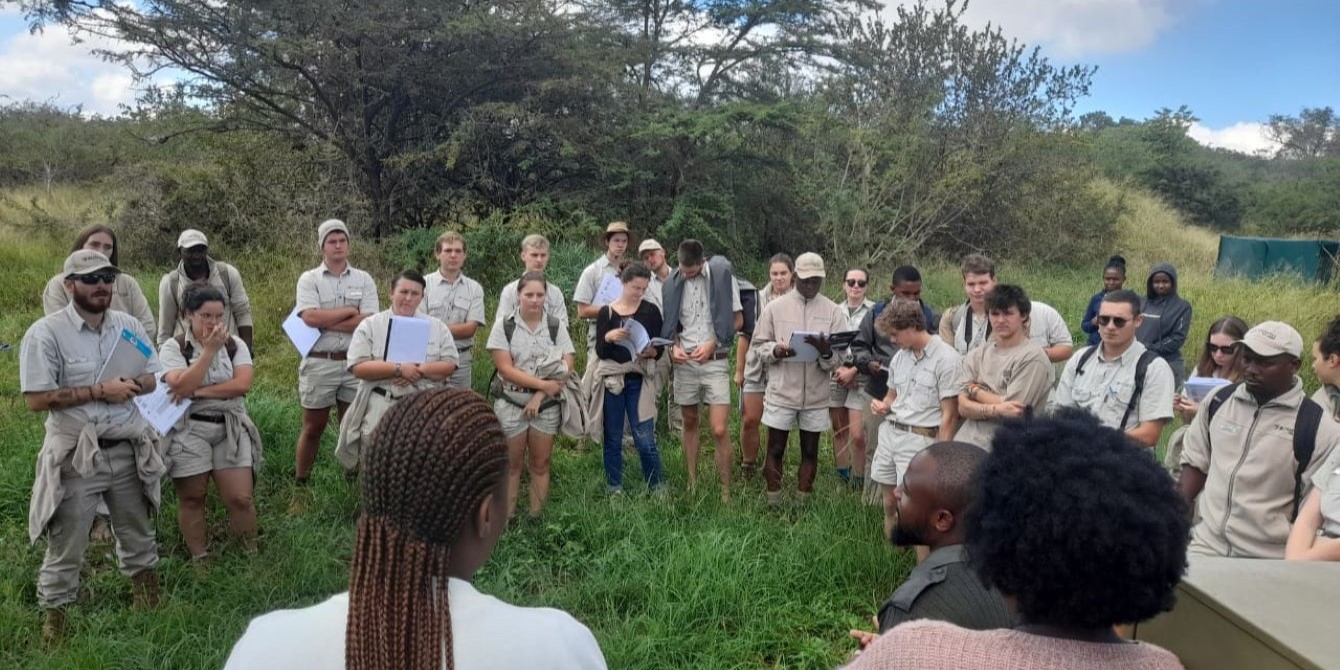
    At the end of this module, students should understand both the conceptual framework and the real-world implementation in conservation and urban landscapes and in the context of present-day African society. Through interactive site visits, students observe the big picture of ecosystem services, including how human populations use those services and resources.

    image

    Practical experiences in the field

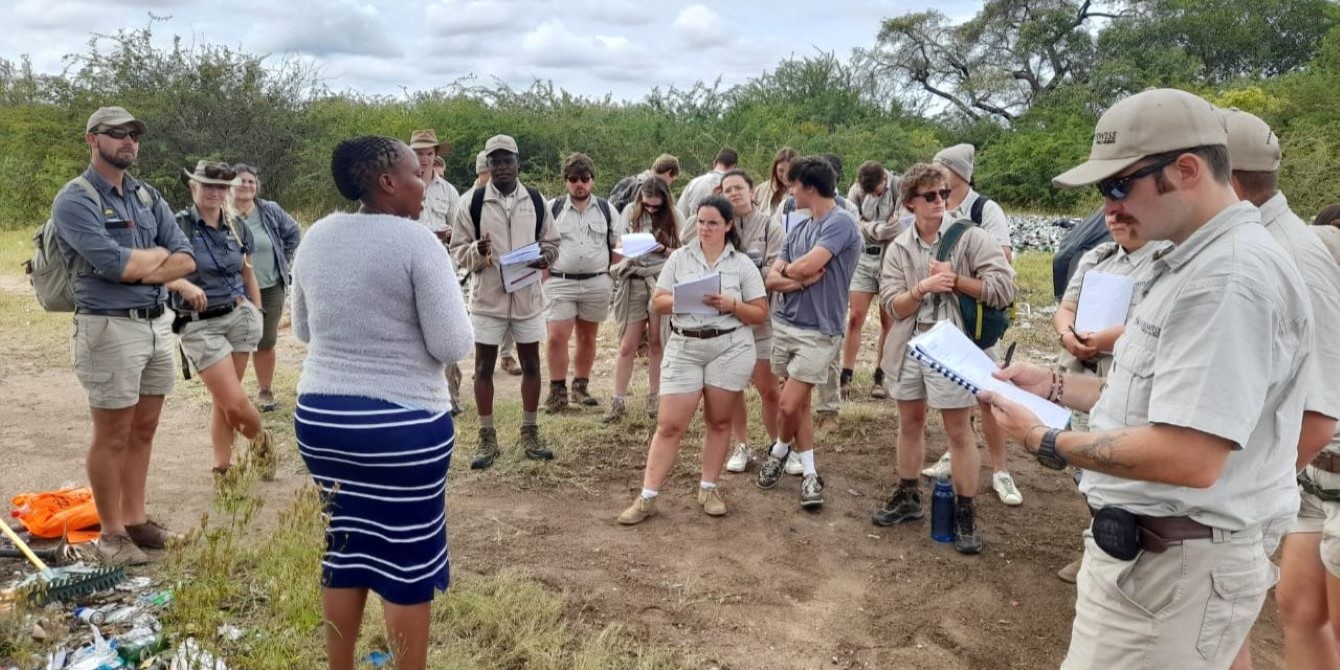
    During this module, students go to different sites near Kruger National Park and learn how companies and organisations incorporate responsible resource management in their activities. We encourage debate and discussion among the students about how we live, what we consume and use, and how we dispose of our waste. 

    In May 2023, Bushwise students participated in this module and alongside their instructors from the SAWC, went to three unique sites to learn about their RRU practices. The sites we visited were Wild Olive Tree Camp, Mzansi Genetics waste site and Nyeleti farming. Each one of these places has incorporated responsible resource use in an amazing way, which we use as an example of what these practices truly mean and the impact they could have.  

    1. Wild Olive Tree Camp was born out of the local community, where there is significant overlap for social and economic applications of RRU. On this site visit, students learned how Wild Olive Tree makes responsible decisions for resource management, and how they minimise their environmental impact.

    2. Mzansi Genetics Waste Site is a registered waste dumping site in Welverdiend, the community bordering Kruger and the Manyeleti. The owner of this waste site collects and sells trash as an income generator. This is an opportunity for students to understand RRU from an economic and ecological perspective, including how to properly recycle and how to prevent air pollution that comes from burning trash.

    3. Nyeleti Farming is located in the agricultural sector and is a great example of the confluence of social, ecological and economic influences in RRU. The farm is relatively small at only 14 hectares, and all of its waste is returned to the soil as compost (they send no trash out of the farm). They plant many different vegetables and many of the resources are used responsibly, including water irrigation across the plantation. 

    We are proud to continue this responsible resource use training alongside the SAWC, as our Bushwise Professional Field Guide students train to become the most responsible, ethical guides they can be. Watch this space to see how the next cohort of field guide students learn about RRU!

    A special thanks to the SAWC for the information and photos contained in this blog.

    #bushwise #qualification #Exam #training #apprenticefieldguide #fieldguidetrainer #ifga #Assessments #fieldguidecourse #studying

  • Track and sign quiz

    To celebrate Bushwise Trainer Pioneer Moyo winning the track and sign category at this year’s Safari Guide of the Year competition, we wanted to share a fun quiz featuring tracks of African animals.

    The species in this quiz are found in the South African lowveld, where Bushwise campuses are based. Take a minute to look at the image and read the options. Then scroll down, where we’ll explain why it is what it is, and how you might distinguish it from something similar!

    Remember, track and sign is all about interpreting marks left behind by animals. No two tracks are ever identical, that’s what makes this both an art and a science! So how well do you know your tracks? Let’s find out…

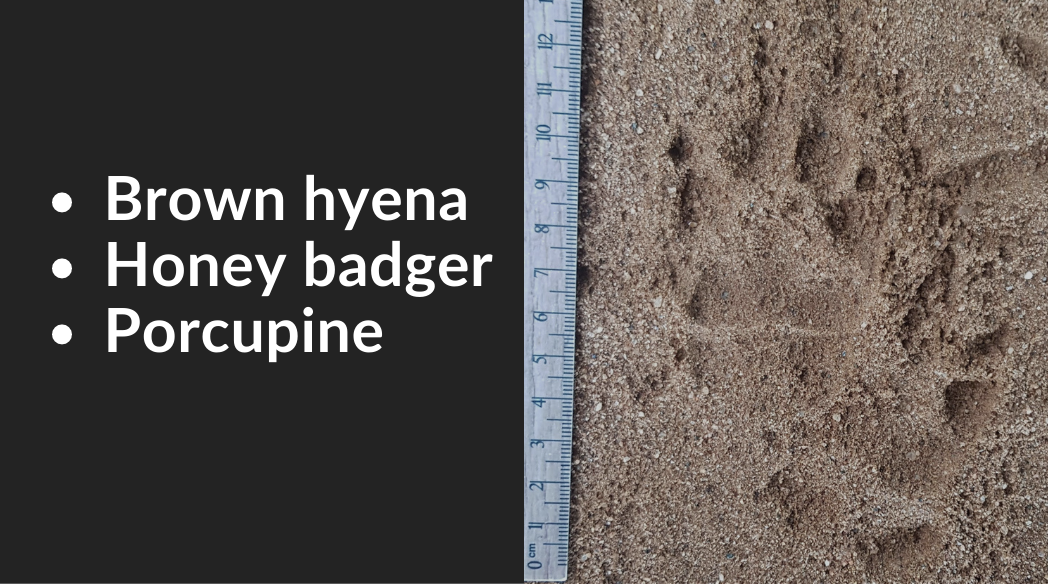
    1. Who left this track?

    image

    Answer:

    Start with the toes – there are four visible and spaced evenly. The claws are close to the toes and the intermediate pad is divided in three, with two additional pads below. This picture actually shows two tracks, one atop the other. This is a porcupine track. Check out this video to see how to distinguish it from a honey badger track.

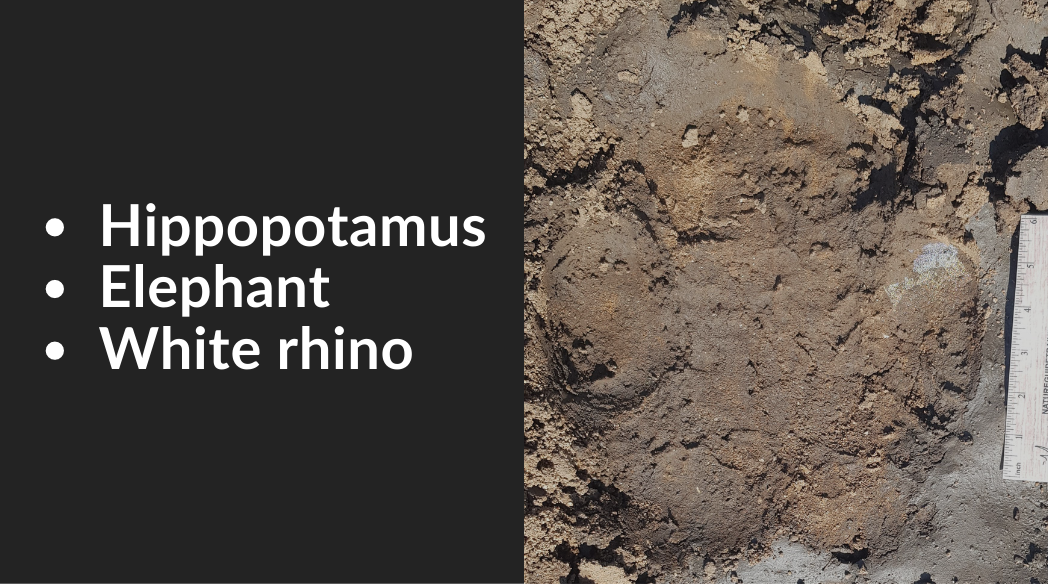
    2. Who left this track?

    image

    Answer:

    See the ruler on the right? This is a biiiig track! So that rules out a lot of things. Even in the mud with some smearing, you can make out three toes – one on top and one on each of the left and right sides. This is a white rhino track. A hippo has four toes, and an elephant track shows as a round or oval shape, with no distinct toes (you may see toenails however).

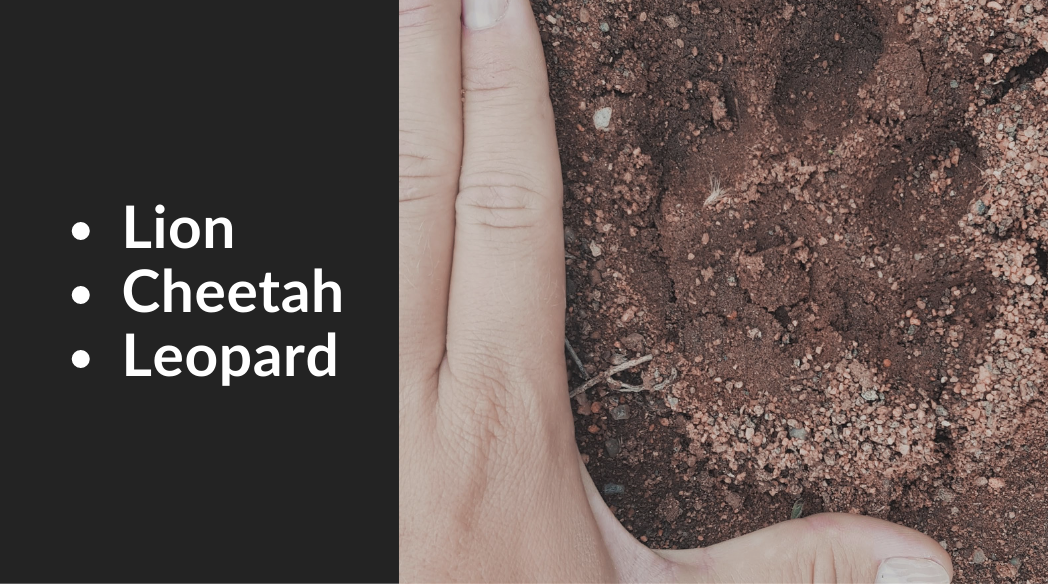
    3. Who left this track?

    image

    Answer:

    Someone left their ruler at home on this day! Our options indicate that this is a cat. It’s a bit hard to see (not all tracks are going to be perfect) but there are no claws present – even in the soft substrate, so it’s not a cheetah (cheetahs have non-retractable claws). The size of the track indicates either a leopard or a small lion. The hint is that this set of tracks was alone, so it wasn’t a young lion in a pride – it was a leopard. Learn more about leopards here.

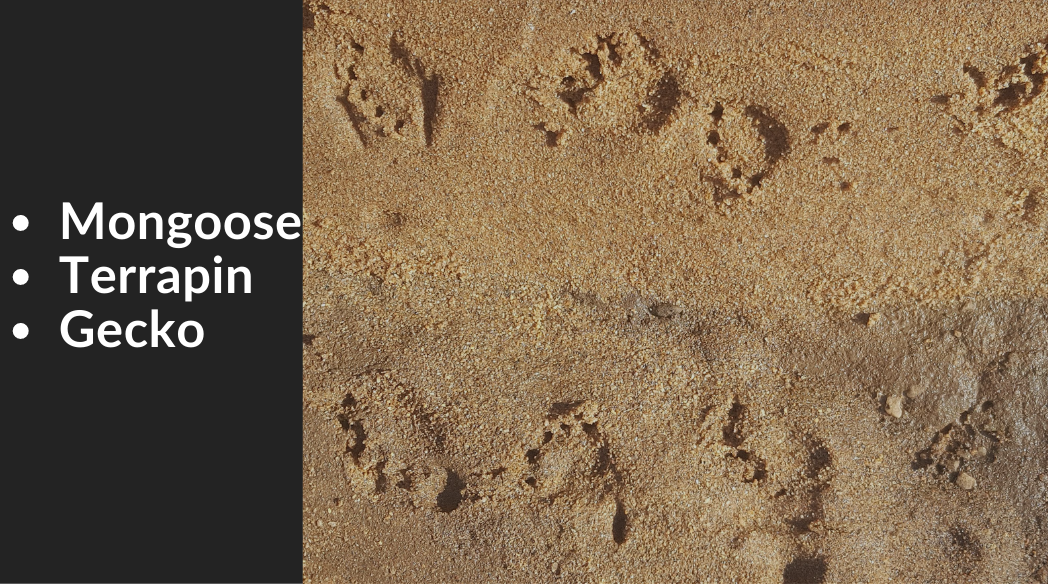
    4. Who left this track?

    image

    Answer:

    Some variety in your answer options here! These tracks were found in a riverbed. You can just make out what looks like a drag mark between the prints – this was the result of the animal’s body lying low and dragging along the sand. The round shape of the track plus the small claws indicate that this is a terrapin.

    5. Who left this track?

    image

    Answer:

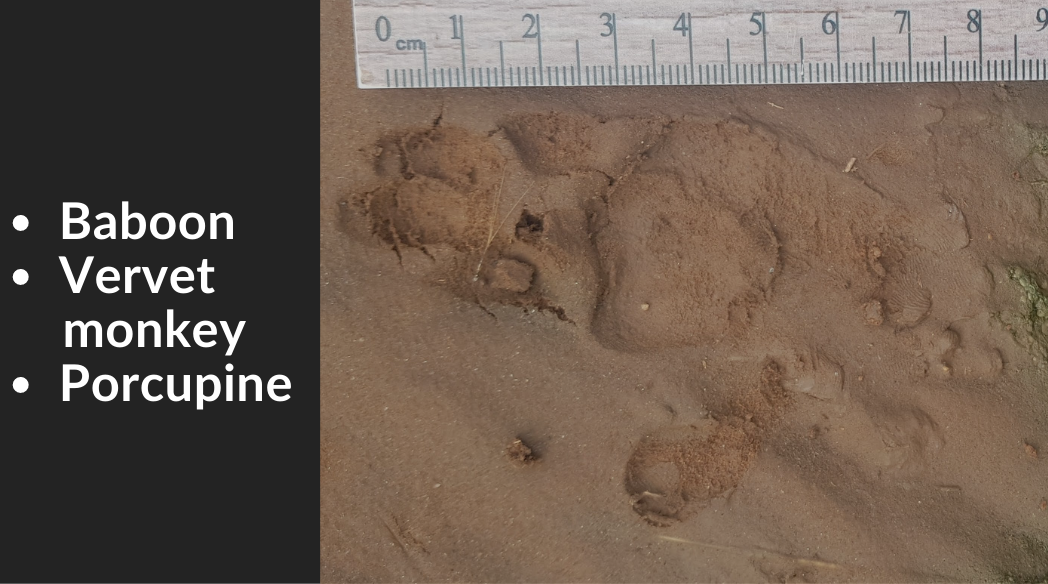
    An oddly human-looking track, isn’t it? If you turn your head to the side, you’ll notice what looks just like a thumb print sticking out to the left, away from the ruler. Baboons and vervets, both Old World monkeys, have tracks that look oddly human. The size of this track means it’s a vervet monkey. More specifically, it’s a vervet’s right hind foot.

    6. Who left this track?

    image

    Answer:

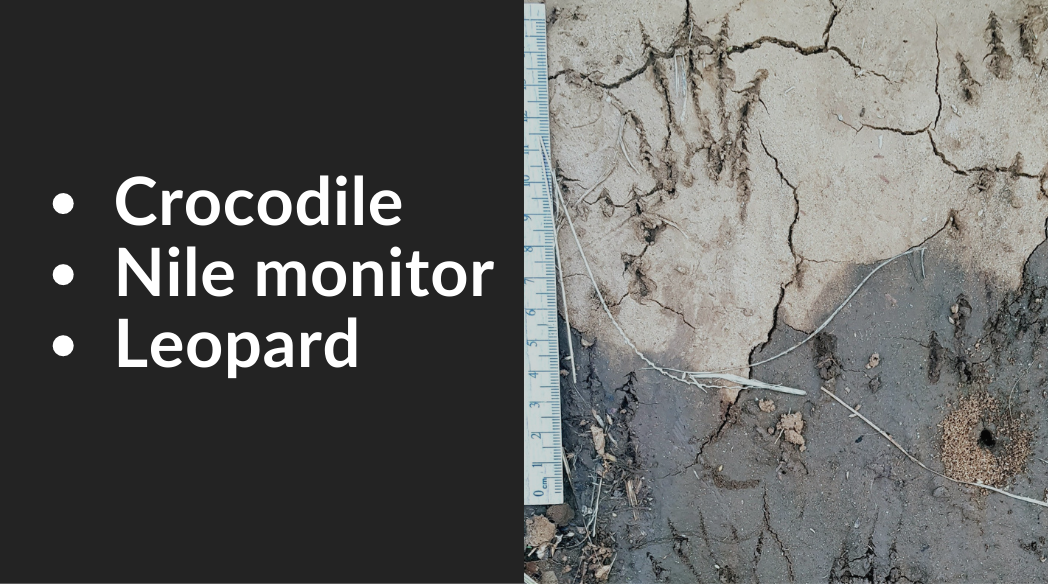
    Claws claws claws! At least that’s certainly the first thing that jumps out in this picture. See how the soil is both wet and dry? This photo was taken in a riverbed. A leopard would have to stretch its claws out and scratch at the ground to make something like this, but it is not a leopard. The size of the tracks (see the ruler) mean they’re too small to be a crocodile. This is a Nile (or water) monitor.

    7. Who left this track?

    image

    Answer:

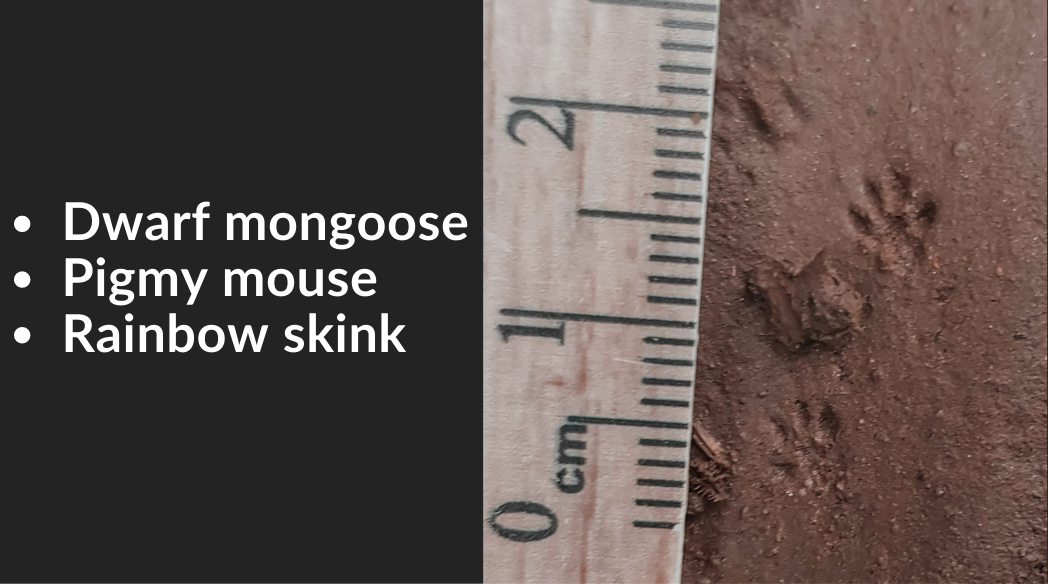
    For the last question of the quiz, we saved the cutest little tracks for last. Coming in at less than half a centimetre long, these tracks are too adorable. In fact it’s rare to see such small tracks as you need specific, soft substrate to record them. Too small even for a dwarf mongoose, these belong to a pygmy mouse.

    How many did you get right? 

    If you’re anything like our Bushwise students, you’ll find that even a taste of track and sign leaves you wanting more. The best solution? Join a wildlife course in the South African bush! Here you’ll train with experts like Colin Patrick Training, or Pioneer Moyo, and enter the incredible world of animal track and sign. Apply today.

    Feature image by Armadillo Media

    #wildlife #wildlifetrack #bushwise #animaltracking #fieldguiding #tracking #trackandsign #Assessments #studying